Q&A Ousman Sonko Appeal
- Who is Ousman Sonko and what is he accused of?
Ousman Sonko is a former Gambian government official who served under the regime of President Yahya Jammeh. Over the course of his career, Mr. Sonko held several senior positions: commander of the State Guard, Inspector General of Police, and, from 2006 to 2016, Minister of the Interior.
He stands accused, and was convicted at first instance, of participating in crimes against humanity committed in The Gambia between 2000 and 2016.
Ousman Sonko was arrested in Switzerland in January 2017, where he had sought asylum. He was tried in 2024 under the principle of universal jurisdiction, which allows national courts to try foreign individuals suspected of international crimes regardless of where they were committed.
- What was happening in The Gambia under Yahya Jammeh’s rule?
Yahya Jammeh ruled The Gambia from 1994 to 2017, following a military coup. His regime was marked by widespread and systematic repression of real or perceived political opponents, including journalists, human rights defenders, members of the security forces, and individuals accused of disloyalty.
During this period, state agents, security forces and affiliated groups, most notably the “Junglers,” a paramilitary unit operating under Jammeh’s authority, were implicated in serious human rights violations. These included arbitrary arrests and detentions, torture, enforced disappearances, extrajudicial killings, and acts of sexual violence.
Many of these abuses were later documented by The Gambia’s Truth, Reconciliation and Reparations Commission (TRRC), which heard from hundreds of victims and witnesses between 2019 and 2021. Its findings highlighted the central role of the regime, including its senior officials and state institutions, in the commission of these violations, and recommended criminal prosecutions for dozens of individuals, including Ousman Sonko.
- What happened during the first instance?
In May 2024, the Swiss Federal Criminal Court (FCC) found Ousman Sonko guilty of crimes against humanity and sentenced him to 20 years’ imprisonment. The Court held that he had participated in a systematic attack against the civilian population under Yahya Jammeh’s regime, through acts including torture, unlawful detention and killings. Sonko was found guilty of i) multiple counts of intentional homicide as crimes against humanity; ii) of multiple counts of false imprisonment as crimes against humanity; iii) of multiple counts of torture as crimes against humanity.
All charges of sexual violence were discontinued. The Court did not determine whether the alleged acts took place; instead, it held that some of the facts were time-barred and that others fell outside its jurisdiction, as they lacked a sufficient link to the broader attack against the civilian population. It also found that certain charges of sexual violence did not constitute acts of torture.
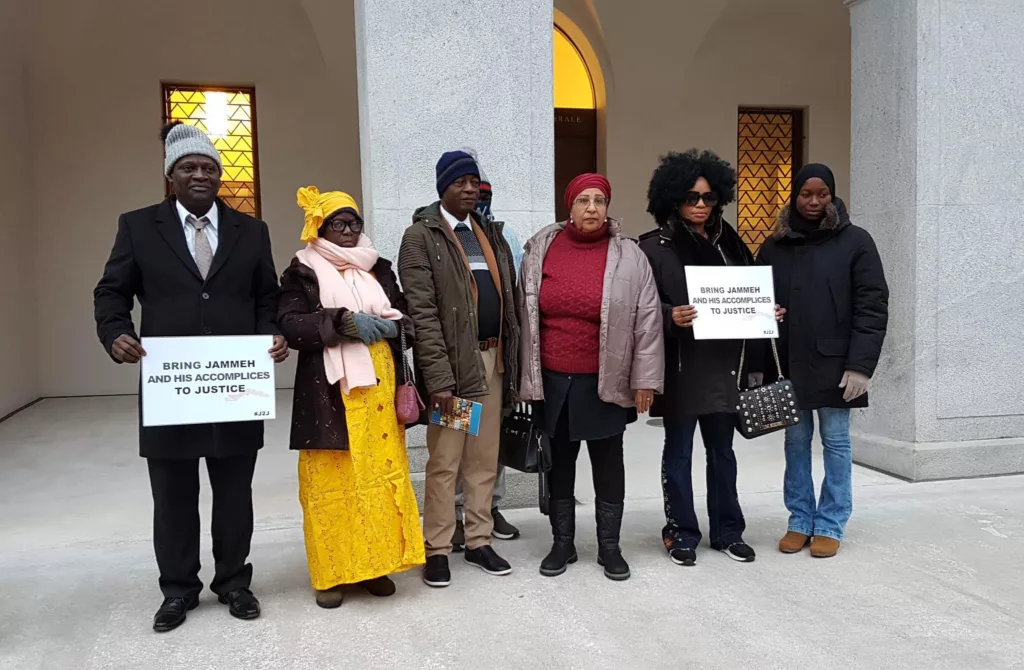
The hearings were held in Bellinzona in January and in March 2024, and 9 plaintiffs from The Gambia flew in to attend the trial.
A Q&A on the first instance proceeding can be found here.
- What aspects of the judgement are being challenged on appeal?
Following the judgment, all parties, namely the accused, the Office of the Attorney General and the plaintiffs, filed appeals on different grounds. While the accused challenges the judgment in its entirety, the prosecution and the plaintiffs contest only specific aspects of the ruling.
Regarding one of the plaintiffs concerned by the sexual violence allegations, the Court ruled that she was not part of the civilian population targeted by the regime, such as journalists, politicians, activists, and others who expressed real or perceived opposition. By doing so, it concluded that the acts she suffered from were privately motivated, rather than part of the broader context of the systematic attack against civilians.
In one instance, acts involving the infliction of pain to the genitals were recognised as torture as a crime against humanity, but were not characterised as sexual violence. The Prosecution and the plaintiffs concerned are challenging these aspects.
- How does the appeal process work in Switzerland?
In Switzerland, criminal appeals trials can involve a full review of a case. In federal proceedings, appeals are heard by the Higher Appeals Chamber of the FCC. At this stage, the judges can reassess both the contested facts and the law, as well as the sentence and other measures decided in the first instance judgment. They may re-examine evidence, hear new witnesses, and either confirm, amend or overturn the original judgment on the issues challenged on appeal.
A further appeal can then be brought before the Swiss Federal Court (the “Swiss Supreme Court”), but with a more limited scope of review. The Swiss Federal Court focuses mainly on legal questions and does not normally reassess the facts. Its role is to ensure that the law was applied correctly and that the proceedings were fair.
- Why is this case important?
This case concerns one of the highest-ranking former government officials ever tried in Europe under the principle of universal jurisdiction.
Ousman Sonko is the most senior Gambian official to face prosecution for crimes committed under Yahya Jammeh’s rule. In Switzerland, his trial marks only the second prosecution of its kind, following the conviction of Alieu Kosiah. At the global level, Ousman Sonko is among the highest-ranking political figures ever brought to trial under this principle, alongside cases such as Hissène Habré.
Together with the convictions of Bai Lowe in Germany and Michael Sang Correa in the United States, the Swiss proceedings contribute to a growing body of judicial recognition of the crimes committed under Yahya Jammeh’s regime. This emerging jurisprudence is likely to support future prosecutions in The Gambia, including within the transitional justice process. The Swiss court itself referred to earlier findings by German courts recognising that crimes against humanity were committed in The Gambia.
- What is TRIAL’s role in these proceedings?
TRIAL International played a key role in initiating the case, having filed the criminal complaint that led to Ousman Sonko’s arrest in 2017. It continues to support the proceedings by liaising between the victims, their legal representatives and partner organisations in The Gambia, helping to ensure coordination, holistic support, and meaningful participation.
TRIAL International ensured on-the-ground monitoring of the first instance trial and will again report from the courtroom during the appeal.
- What is AVLO?
The Association of Victim-Led Organisations (AVLO) is a Gambian non-profit organisation established in January 2024 to champion and represent the interests of victims of human rights violations during the era of former president and dictator Yahya Jammeh in the implementation of the TRRC’s recommendations.
AVLO is an alliance of local victim organisations and associations, including the African Network against Extrajudicial Killings and Enforced Disappearance (ANEKED), Gambia Centre for Victims of Human Rights Violation, Survivors of the Presidential Alternative Treatment, Fantanka, Solo Sandeng Foundation, Women’s Association for Victim Empowerment (WAVE), Women in Leadership and Liberation (WILL), and Yelef Initiative. The organisation aims to advocate for and support victims and survivors of human rights violations in seeking justice and to receive reparations that are adequate, effective, prompt, and proportional to the gravity of the violations and harm the victims have suffered.
 Global