The Lumbala Trial – Week 5
(8-12 December 2025)
Closing Phase of the Trial: Final Testimonies and Pleadings
Roger Lumbala and his defence did not appear in court throughout the fourth week of the trial.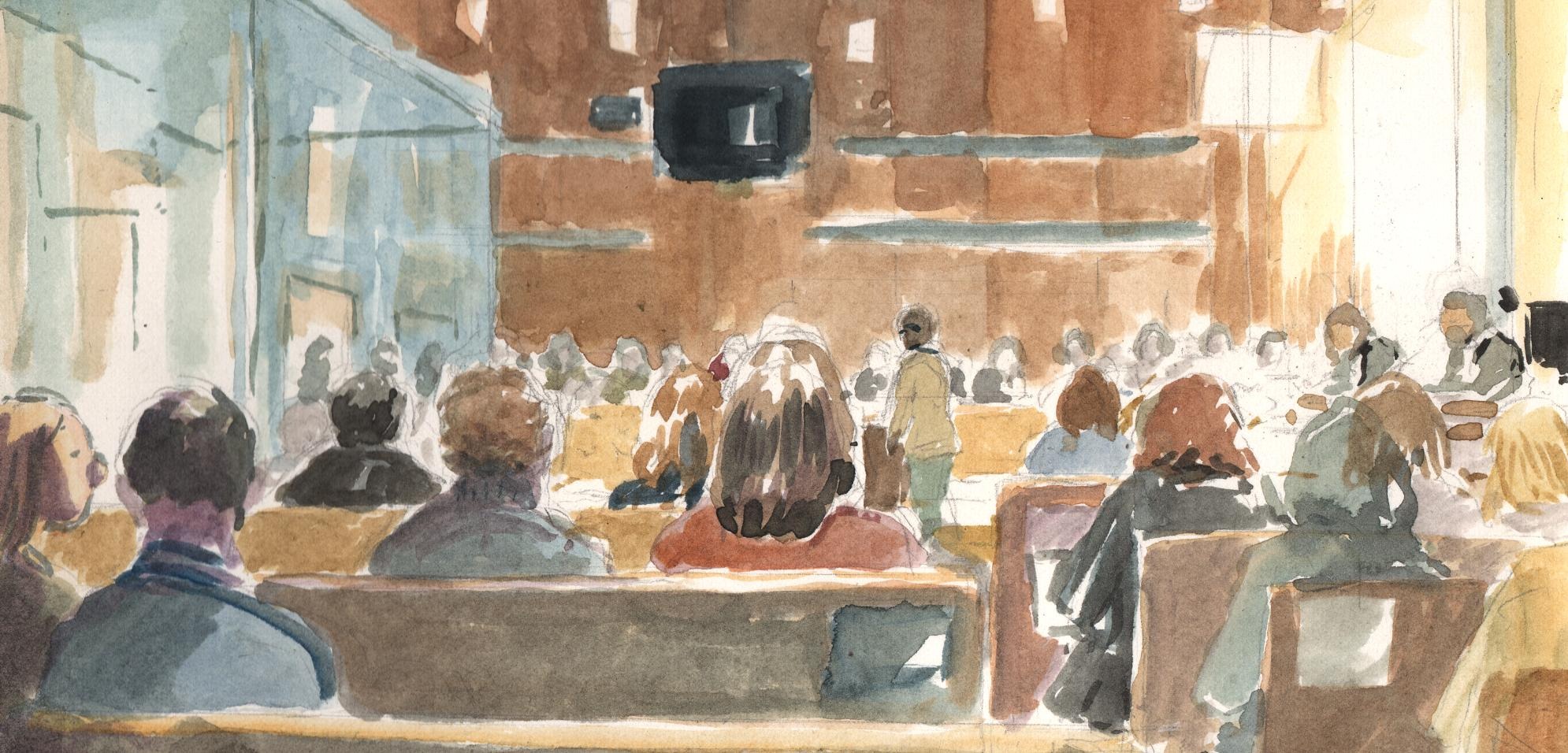
Day 19 – Monday 8 December
Psychiatric expert, Dr Daniel Zagury (who had examined Roger Lumbala in 2021), described the accused as a calm, coherent man, without any pathology or impairment. Lumbala’s account is described as coherent and firm, marked by self-assurance and a clear lack of guilt. He denies any personal involvement in the alleged acts of violence, which he placed within a context of armed conflict and political engagement that he presents as being intended in the interests of the population.
Two witnesses from Bafwasende are then heard. They recounted the takeover of the area by the RCD-N, accompanied by looting, extortion of property, imposed taxes, forced labour and summary executions. They also described the arrest of the local chief, who is civil party to the proceedings, and his transfer by helicopter to Isiro, as well as violence against civilians, including killings, rapes and arbitrary detentions. In particular, one witness reported the murder of members of his family and attacks linked to the exploitation of diamond resources. The second witness broadly confirmed these facts and specified the composition of the forces deployed.
The final hearing took place behind closed doors at the request of the witness, who is heard as a defence witness. A former senior member of the RCD-N, he provided a detailed description of its internal organisation, the distribution of political and military responsibilities, and the administrative functioning in mining areas.
Day 20 – Tuesday 9 December
A witness from Epulu described the arrival of the “Effacers” in 2002, characterised by systematic looting, extortion of food supplies and several summary executions. He also recounted acts of sexual violence against women from the village, as well as the transfer of goods to Bafwasende. He stated that, a few days after the occupation, he saw Lumbala give a public speech, announcing the arrival of reinforcements and distributing some food supplies to the population. He described the extortion suffered by his own family, the use of APC uniforms by certain “Effacer” fighters, and gave names of military commanders identified on the ground.
Three civil parties then testified in succession. The first described the takeover of Epulu in 2002, the complete looting of her home, the loss of her livestock and the death of her brother, who was shot after returning to the village.
The second, who was a teenager at the time, reported having been captured in Mandima and then raped in public in front of her family, while her home was simultaneously ransacked.
The third, a local chief, recounted his arrest, his detention with other civilians, and being tortured with burning embers. He mentioned the looting of the hospital and his home, the rape of detained women, as well as a new offensive in December 2002, during which the attackers reportedly claimed a force of 750 men and benefited from helicopter supply deliveries.
At the end of the hearing, a Congolese journalist who was called as a defence witness, provided context on the politico-military situation. He described the emergence of the RCD-N from fighters originating from the MLC and the RCD-K/ML, gradually integrated around Bafwasende and then Isiro. Several articles published between 2001 and 2003 in the newspaper Le Millénaire, of which he was editor, are read out in court. They recounted the establishment of the RCD-N, the administration exercised in these localities, and the implementation of a system of mining taxation, while also relaying certain local criticisms directed at Lumbala’s political management. Two articles by the same journalist published in 2022 cast doubt on the proceedings initiated in France.
Telephone records entered into evidence showed a correspondence of dates between these publications and exchanges between Lumbala and a member of his family.
Finally, the Court read several social media posts by the witness, written at the time of Lumbala’s arrest in France, in which he describes him as a “warlord”, referring to looting, the exploitation of natural resources and the involvement of his troops in Operation “Erasing the Board”, as well as the abuses that allegedly accompanied it.
Day 21 – Wednesday 10 December
Defence witness Robert Ombilingo was heard via videolink from Kinshasa. He explained that he met Lumbala in Bafwasende in June 2000, upon his arrival by helicopter, shortly before the proclamation of the RCD-N.
He described how Lumbala took control of the territory with the support of Ugandan soldiers and RCD-K/ML troops who had remained in the area, and how he himself was then recruited into the movement’s administration.
The witness reported that after the dissolution of the FLC, the RCD-K/ML regained control of Bafwasende, and that he was arrested and detained for several months in Beni before Simon Tshitenge organised his evacuation to Isiro. Upon his arrival there, Lumbala entrusted him with the position of national secretary for finance.
Regarding the management of Isiro, he stated that the situation was calm and that there was “almost no war”. According to him, the taxation that had been introduced did not constitute a “war effort” but was used to finance Lumbala’s travel and the civil administration. He maintained that military supplies came from Gbadolite, while acknowledging that they would “sometimes make arrangements” to feed the soldiers on site.
He stated that he had no knowledge of any abuses committed in Isiro, Bafwasende or elsewhere under RCD-N control, and asserted that Mambasa had never been under the movement’s authority. He said that he knew nothing about relations between Lumbala and the military, specifying that only Roger Lumbala and Constant Ndima discussed operational matters. He claimed never to have heard of an operation called “Erasing the Board”, which he described as merely a “nickname” attributed to Ndima. He nevertheless confirmed having seen soldiers arrive in Isiro with mutilated genitalia used as trophies, specifying that they were under the command of Colonel Widy Ramses.
Obilingo denied allegedly threatening other witnesses. The court noted that he appeared to be writing down the names mentioned; the sheet is then taken away from him.
At the end of the hearing, and after providing a brief recap of the various elements presented to the court over the five weeks of hearings, the President set out certain legal notions at the heart of the questions put to the jurors, including the constituent elements of crimes against humanity, the different forms of complicity and what characterises them.
Day 22 – Thursday 11 December
The day was dedicated to pleadings of the lawyers for the civil parties.
Counsel Thulliez discussed the conditions under which the victims were identified, protected and brought before the Court, emphasising the risks incurred. He set out the elements of evidence that he considers convergent, the credibility of the testimonies heard, the existence of troops belonging to, or placed under, the control of the RCD-N, as well as the conduct of Operation “Erasing the Board”. He also addressed the acts of looting and argued for their qualification as crimes against humanity by way of other inhumane acts, before recalling the contextual elements of crimes against humanity.
Counsel Bectarte spoke about the principle of universal jurisdiction and the central role of victims in the Court’s legitimacy. She referred to the support work carried out by partner organisations. She then discussed the systematic nature of the sexual violence reported by several civil parties, and its use as a weapon of war. She argued for the responsibility of Roger Lumbala as a leader who enabled the commission of these crimes.
Counsel Deniau situated the facts in the context of natural resource exploitation in the DRC. She referred to the recapture of Bafwasende, the systems of taxation and looting put in place, and described the acts suffered by the civil parties she represents and their lasting consequences. She returned to the role exercised by Lumbala within the RCD-N and to his authority over the troops.
Counsel Brengarth recalled Lumbala’s absence from the hearing and set out the acts suffered by the civil party he represents, stressing that following his testimony, he was granted refugee status due to threats and reprisals he had suffered.
Counsel Mouldaia referred to the absence of a key witness he represents, returning to that witness’s involvement in the proceedings and to the elements supporting the credibility of his testimony. He also described the torture suffered by that witness. Counsel Delapalme added accounts of summary executions, violence in the collection of taxes and arbitrary detentions, in particular at Isiro Matari airport.
Counsel Lindon addressed the principle of universal jurisdiction and the defence strategy adopted by Lumbala. She then described how sexual violence was used to break communities.
Finally, Counsels Sarron, Sulzer and Witt presented the documentation work carried out by the organisations they represent. They described the situation of the Bambuti people, the persecution they have suffered, and the crimes committed against them.
The day concluded with a reminder of the facts examined during the hearings, the forms of enslavement denounced, and the expectation of justice expressed by the civil parties.
Day 23 – Friday 12 December
The prosecution noted the contradictory nature of Lumbala’s opposition to the French courts and his absence, recalling Lumbala’s active participation in the investigation over several years, and stressed that his absence from the trial does not undermine the fairness of proceedings marked by a thorough investigation and five weeks of adversarial hearings.
In its submissions, the prosecution recalled that the trial was not intended to judge all crimes committed in the DRC, but to establish the individual criminal responsibility of Roger Lumbala. It emphasised that the holding of the trial constitutes a significant step forward despite the lack of judicial cooperation from the DRC and the pressure exerted on witnesses, and called on the jurors to answer methodically the questions submitted to them in order to contribute to the establishment of a judicial truth regarding the crimes committed in 2002–2003.
The prosecution placed the facts within the context of the Second Congo War, marked by the fragmentation of armed groups and the predation of natural resources. Operation “Erasing the Board” was part of a territorial control logic, and constituted a culmination of violence, characterised in particular by mass rapes and mutilations.
The prosecution retraced Lumbala’s path, presenting him as having deliberately chosen armed struggle as a means of accessing power. Supported first by Ugandan actors and later by Jean-Pierre Bemba, he established himself in Bafwasende and Isiro, where he administered the territory through force. Contrary to his statements, the existence of troops placed under the authority of the RCD-N is established by witness testimonies, NGO reports, press articles and his own previous statements.
The prosecution maintained that Lumbala exercised effective authority over these troops, maintained direct links with their commanders, and played a central role in the logistics of Operation “Erasing the Board”, in particular through taxation and looting, control of mining resources and the supply of fighters.
The facts are then examined locality by locality (Bafwasende, Isiro, Epulu, Mambasa, Mandima), revealing a recurrent modus operandi: looting, arbitrary arrests, torture, rape, forced labour, summary executions and destruction targeting in particular the Nande and Bambuti communities. These elements make it possible to characterise crimes against humanity committed as part of a widespread and systematic attack against the civilian population.
The prosecution seeks Lumbala’s conviction for complicity in crimes against humanity by instigation, aid or assistance and culpable omission, as well as for participation in an agreement to commit crimes against humanity, in connection with the strategic alliance concluded with Jean-Pierre Bemba and the planning of Operation “Erasing the Board”. The prosecution requested partial acquittals for certain acts insufficiently substantiated with regard to two civil parties. In view of the gravity of the crimes and the personality of the accused, the prosecution seeks a sentence of life imprisonment, the confiscation of seized items and a permanent ban from French territory.
 Global