The Lumbala Trial – Week 3
(24-28 November 2025)
First Testimonies of Individual Civil Parties
Roger Lumbala and his defence did not appear in court throughout the third week of the trial.
Day 9 – Monday 24 November
The day began with the hearing of an insider witness, former intelligent officer of the RCD-N. The witness explained the origin of the RCD-N, and the influence Uganda played in relaying orders. On the chain of command, the witness explained that Roger Lumbala was part of strategic discussions with Jean-Pierre Bemba, and General Amuli, and after him, General Ndima. The witness described how pillage was a way to compensate troops stationed in Isiro.
The court then proceeded to hear C.M., a civil party who, at the time of the events, was an elder in a town in the Tshopo Province. C.M. described how Lumbala and the RCD-N gradually established their control in his town, supported by the UPDF, and their takeover of diamond exploitation. He recalled summary executions perpetrated by Ugandan general K., disappearances over disputes over the diamond trade, and the looting and torture he himself suffered, including being thrown into holding cells and mistreated in a pit known as “Mabusu,” as well as the conditions of his detention between Bafwasende and Isiro. C.M. also shared how he has been threatened, prior to his testimony, by founding members of the RCD-N.
Next, civil party D.U. explained how he lives under protection due to threats linked to his testimony. Barely a teenager at the time of the events, he described being tortured, including a gunshot wound after being forced to guide soldiers under Lumbala’s command to a diamond site. He recounted how he witnessed several public executions in Lumbala’s presence, and described how the RCD-N counterattacked when Bafwasende was taken by the Michigan’s Mai-Mai.
One of the civil parties’ lawyers submitted several documents to the case file relating to the effects of trauma on memory, including traumatic amnesia and difficulties in recalling dates.
Day 10 – Tuesday 25 November
The day began with the testimony of D.N., who, at the time of the events, was a pastor in the Tshopo Province. He described the arbitrary taxation system established by Lumbala, enforced by violence. He shared how his own brother had been killed, and how he himself was detained and tortured.
D.N. also described how another civil party, D.U., was seriously wounded as a child by Lumabla’s troops. He also recounted the fight for Bafwasende between the RCD-N and the Mai-Mai militia. He is also facing threats due to his testimony.
Next, civil party B.A. testified about the violence he suffered as he was attempting to sell diamonds without going through the trading post controlled by Lumbala: he was beaten by soldiers and robbed. He explained how Lumbala had total control over the town with the support of Ugandan soldiers and fighters provided by Bemba. He, like other civil parties, had been threatened due to his role in the trial.
D.D, representative of the civil party NGO PAP-RDC was heard next: he outlined the organisation’s origins and mandate, and detailed the three pillars of their work: legal, psychological, and medical. He expressed concerns of reprisals, considering how much the trial has been reported on.
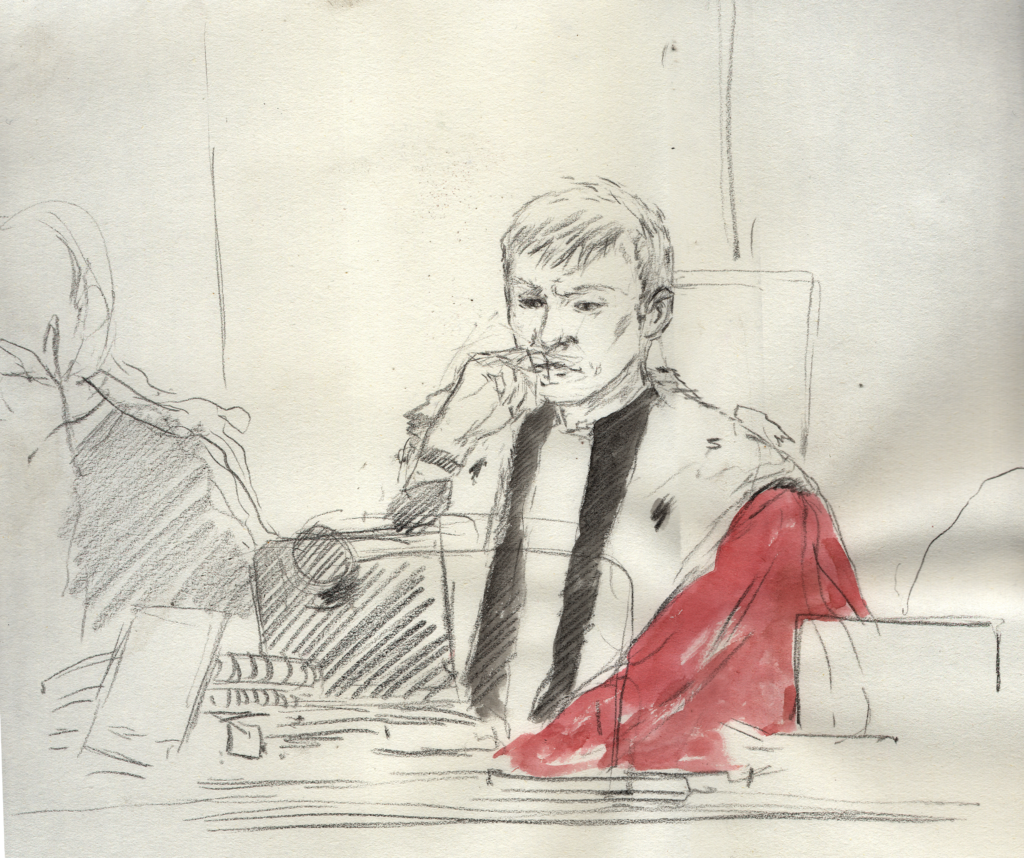
The Presiding judge then read several witness accounts who described the takeover of Isiro by the RCD-N in 2002, the taxation system established by Lumbala, and several crimes, such as public execution, mutilations, persecution targeting the Nande people, and violent military operations conducted around town. The witnesses also described the arrival of MLC reinforcements to bolster the RCD-N.
The Presiding judge also presented the statements of a senior officer of the RCD-N, who had been interviewed many times during the investigative phase. In his accounts, he explained the origin, structure, and functioning of the RCD-N in Isiro. He had also disclosed the taxation system, and various abuses committed in Isiro between 2002 and 2003. The lawyer of the civil parties raised the fact that this senior officer had also been assaulted in Paris in connection with the case before being denied asylum, illustrating the pressures on Congolese individuals involved in the proceedings.
Audiovisual reports, both old and recent, have been submitted by the lawyers of the civil parties.
Day 11 – Wednesday 26 November
P.Y., a Bambuti traditional leader, described the attacks on his community during operation “Effacer le tableau” and the extreme violence suffered by his family: how his pregnant sister was gang-raped and died from the injuries, and how his aunt was also raped.
He spoke in general about the looting that was carried out against his people, which included the destruction of traditional objects.
Responding to allegations that NGOs had manipulated testimonies, he stressed the supportive and non-directive nature of their assistance, and the significant risks taken by witnesses in coming to testify.
Next, civil party A.M. recounted how he was forced to work for troops during the “Effacer le tableau” operation in Epulu in October 2002: they were forced to build huts, carry loads, and he was beaten until unconscious.
A civil party heard in a closed session, recounted the sexual violence they were subjected to, and hoped the testimony would prevent future crimes of the same nature from happening again.
The civil party W.M. testified about the looting that took place during the two back-to-back captures of Epulu in late 2002, and how W.M. had her property seized by Colonel Freddy Ngalimu, alias Mopao.
W.M. described the several killings and the forced mobilisation of young men to carry the loot, as well as a brief exchange she had with Roger Lumbala during his visit to Epulu. She also reported receiving threats, in particular by long-standing members of RCD-N, and firmly refuted allegations of witness tampering by detailing her interactions with the NGOs supporting her.
The hearing ended with the reading of Lumbala’s statements from his confrontations with several civil parties and witnesses during the investigation.
Day 12 – Thursday 27 November
The first hearing was civil party M.O., who described the capture of Epulu during operation “Effacer le tableau”: the abduction of women, the forced transport of ammunition and heavy loads, as well as the whippings inflicted on those who were forced to carry them.
M.O. mentioned how his brother and other residents (including pastor R.), were murdered during the second take-over of the village by the RCD-N. He also spoke about the two visits made by Roger Lumbala to Epulu, one to deliver ammunition by helicopter and the other for a public meeting, as well as the chain of command involving Freddy Ngalimu and the commanders of the battalions.
Next was V.R., who recounted repeatedly fleeing from soldiers of the “Effacer le tableau” operation fighting against troops from the APC. She described the killing of her father, Pastor R., alongside two other victims, the forced labour imposed on her brothers, and the looting her family suffered. She also recalled Roger Lumbala’s public meeting in Epulu and the intervention of M.O., as well as the threats she received after travelling to France.
A civil party, heard during a closed session, described fleeing during the “Effacer le Tableau” operation, and testified to being publicly raped twice. They shared how they feel shame and anger.
Witness K.K., a resident of Butiaba described how nearly 2000 soldiers under Roger Lumbala’s command arrived in the village, the establishment of their military headquarters, and the stockpile of ammunition transported by vehicle towards Some. Goods looted by the soldiers were transported with a helicopter on three occasions – these operations were carried out under the supervision of Colonel Widi Divioka.
The hearing ended with the reading of Lumbala’s statements from his confrontations before the investigating judge. He denied any direct role in General Ndima’s command or in the abuses and summary executions in Isiro, claiming that troop control rested with Jean-Pierre Bemba and that he was not present during the military operations or crimes attributed to RCD-N soldiers.
Day 13 – Friday 28 November
Three civil parties were heard behind closed doors as their testimony focused on sexual violence committed during the attacks on Epulu. They also described the lasting physical, psychological and socio-economic impact these events still have on their daily lives.
The court then proceeded to read contemporary press articles (local, national and international media), as well as radio excerpts containing interviews with Roger Lumbala. This sequence aimed to reconstruct the chronology of events and highlighted that the RCD-N was consistently described as an armed group in the media at the time.