Challenges and opportunities in implementing Universal Jurisdiction in Senegal
The 13th of our series of Universal Jurisdiction Law and Practice Briefing Papers, focusing on the law and practice of universal jurisdiction in Senegal, was launched on 18 November 2026. It was presented at a round-table discussion in Dakar, organised in collaboration with IRA Think Tank, a Senegalese civil society organisation. It is currently being translated into English.
The event brought together around twenty participants from a variety of backgrounds, including academics, legal practitioners, students, representatives of civil society, a number of journalists, as well as the Attorney General at the Dakar Court of Appeal and the Director of the Judicial Training Centre. The discussion that followed the presentation of the report covered various aspects of the implementation of universal jurisdiction in Senegal.
Universal jurisdiction in Senegal
Senegal holds a unique position in the field of universal jurisdiction owing to the case of the former Chadian president, Hissène Habré, who was tried in Dakar by the Extraordinary African Chambers. This case has served as a prime example of the exercise of jurisdiction beyond the traditional criteria of territoriality and nationality, whilst helping to shape developments in national legislation.
The Briefing paper on the law and practice of universal jurisdiction in Senegal provides an analysis of the domestic legal framework and the practice of universal jurisdiction in the country with regard to international crimes. It focuses on the crimes of genocide, crimes against humanity, war crimes and torture, as defined under Senegalese law. It analyses the applicable rules on universal jurisdiction, the conditions for its implementation, and the institutional and procedural mechanisms employed in this context. Its content is based on a documentary analysis of the applicable law as well as on interviews conducted with several practitioners, some of whom took part in the round table.
Part of the discussions at the event also focused on the difficulties and obstacles to implementing universal jurisdiction in Senegal, particularly in terms of the law, practical realities and financial requirements. There is also a need for training in this area. Cooperation between stakeholders could be improved, so that civil society can take ownership of the justice system and victims are given a greater voice. This also includes better witness protection.
Other issues raised included access to justice for women victims of violence – particularly sexual violence – as well as the question of immunities and the conditional nature of the exercise of universal jurisdiction in Senegal. Part of the debate also centred on the superiority of international treaties over national law versus the need to incorporate them into legislation before they can be applied.
Tools to understand the laws and practice of universal jurisdiction
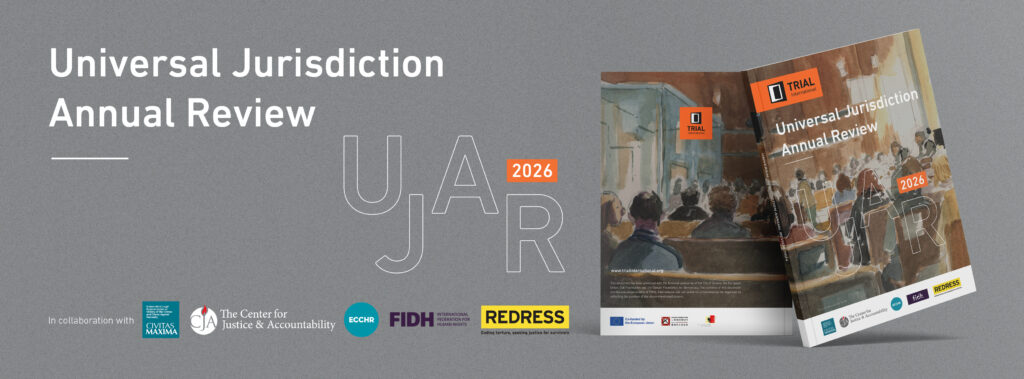
The aim of this series of analyses of the laws and practice of several countries regarding the investigation and prosecution of crimes under universal jurisdiction is to help legal practitioners gain a better understanding of national judicial systems, with a view to facilitating the development of litigation strategies.
In 2025, TRIAL International decided to continue the series, seeking to extend the analysis beyond Europe and North America in order to examine developments in universal jurisdiction in other countries. In 2025, this work was carried out in relation to Argentina, where, at that time, several cases had been brought on the basis of universal jurisdiction. (also available in Spanish) Senegal was chosen in 2026. It will be followed by South Africa in 2027.