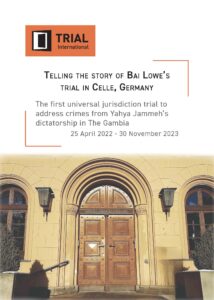
Telling the story of Bai Lowe’s trial in Germany
The first universal jurisdiction trial to address crimes from Yahya Jammeh’s dictatorship in The Gambia
Four years ago this week, the first universal jurisdiction trial to address crimes from Yahya Jammeh’s dictatorship in The Gambia was opening in Germany. TRIAL International now publishes the story of this trial against former Jungler Bai Lowe.
Context of the case
As part of the regime’s institutionalised violence, Jammeh set up a clandestine hit squad, known as the “Junglers”. This unit was tasked with intimidating and eliminating any potential or actual threat to his power. Its members allegedly committed numerous acts of extrajudicial killings, torture and other serious human rights violations.
After fleeing The Gambia for Germany in 2012, former Jungler Bai Lowe gave two interviews to Gambian journalists in 2013 and 2014, in which he described in great detail the killings and shootings he participated in while he was driving other members of the Junglers.
Overview of the case
TRIAL International and the European Center for Constitutional and Human Rights (ECCHR) informed the German prosecuting authorities in 2019 of the suspect’s presence on German territory. The legal principle of universal jurisdiction made the investigation by the German Federal Police and the arrest of Bai Lowe in March 2021 possible. He was indicted for the murders of Gambian journalist Deyda Hydara in 2004 and of former soldier Dawda Nyassi in 2006, as well as for the attempted murder of lawyer Ousman Sillah in 2003, as crimes against humanity in March 2022.
Bai Lowe’s trial opened on 25 April 2022 before the Higher Regional Court of Celle. On 30 November 2023, Bai Lowe was sentenced to life imprisonment for the two above-mentioned murders and the attempted murders of Sillah and two of Hydara’s colleagues during his shooting in 2004, all as crimes against humanity.
The verdict was historic, as it was the first legal recognition of the commission of crimes against humanity during Jammeh’s rule. Bai Lowe’s conviction became final when it was confirmed by the German Federal Court of Justice on 12 November 2024.
Monitoring a trial held in Germany on Gambian crimes
Taking place over 4 000 kilometres away from The Gambia, Bai Lowe’s trial in Celle was entirely held in German. To ensure the trial monitoring, TRIAL International, Human Rights Watch and the International Commission of Jurists put in place a project with a group of law students of the Georg-August-University of Göttingen, in coordination with the Göttingen chapter of the European Law Students’ Association.
Telling the story of Bai Lowe’s trial
This publication was drafted and reviewed by international and Gambian NGOs who worked on the criminal procedure and have thorough knowledge of the past and current historical and political Gambian context. It is intended to tell the story of Bai Lowe’s trial on the basis of the notes taken by the students, through a thematic description of the trial hearings in view of highlighting the main stages and stakes of the procedure. It is neither a legal analysis of the procedure, nor a transcript or a chronological account of the trial hearings. It is meant to be a resource that Gambian communities and interested law practitioners can consult to understand what happened for a year and a half in the courtroom of the Higher Regional Court of Celle
It is crucial that foreign procedures be made accessible to Gambian communities, so they can understand how justice for the crimes they suffered can be made abroad. This publication is part of this dynamic.
“If this trial is to have an impact beyond its immediate legal outcome, it will depend not only on the authority of the judgment, but also on the ways in which it is documented, interpreted, and communicated.”
Susann Aboueldahab, Inês Freixo & Rodolfo González Espinosa
A part of the justice and accountability process
This criminal procedure has been crucial as part of accountability efforts of the Gambian State, pushed by the strong mobilisation of Gambian civil society through the activism of victims and survivors. It has also illustrated the power of extra-territorial and universal jurisdiction in fighting the impunity of international crimes.
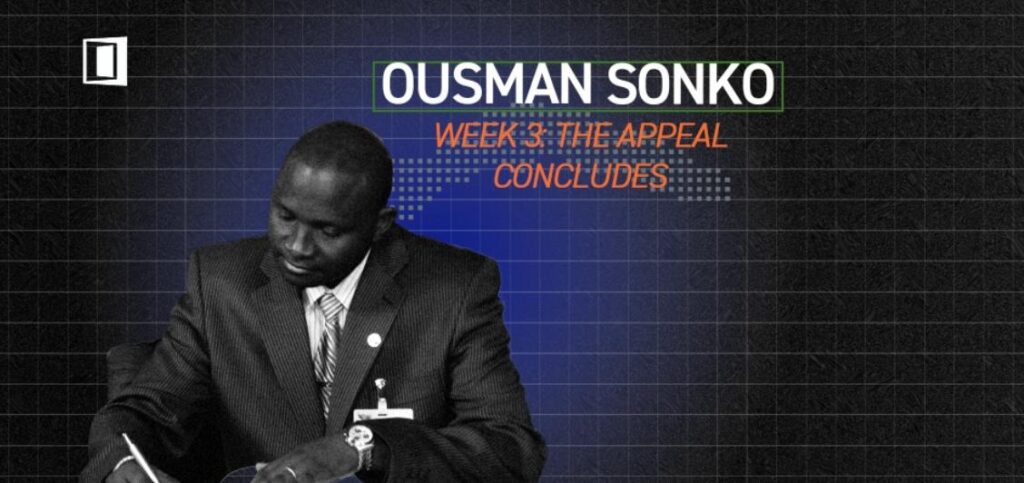
Indeed, Ousman Sonko, Jammeh’s former Minister of Interior, was subsequently tried for crimes against humanity in Switzerland in 2024, as well as Michael Sang Correa, another Jungler, tried for torture and conspiracy to commit torture, in the United States in 2025. In the meantime, in furtherance of the work of the Gambian Truth Reconciliation and Reparations Commission (TRRC) created in 2018, the national Assembly passed the Special Accountability Mechanism (SAM) bill in April 2024, thereby committing to prosecute serious human rights violations committed during Jammeh’s rule.
TRIAL International thanks the African Network against Extrajudicial Killings and Enforced Disappearances (ANEKED) for their collaboration in discussing the outreach issues and challenges surrounding this trial, as well as for their precious review of this publication.
Read and download the Publication here:
 Global