The Rifaat al-Assad case: the perseverance of the plaintiffs
On 31 March 2026, the Criminal Division of the Swiss Federal Criminal Court (FCC) issued an order to close the case against Rifaat al-Assad following his death. The case had been referred to it on 11 March 2024 with an indictment by the Office of the Attorney General of Switzerland, following more than 10 years of investigation into one of the most atrocious massacres in the country’s history, perpetrated in the city of Hama in February 1982.
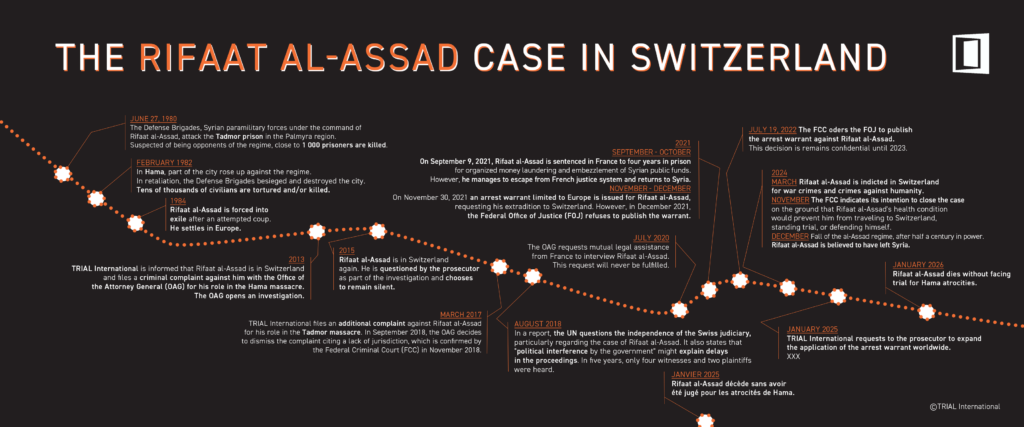
Whilst this decision brings the proceedings to a final closure, it in no way diminishes the courage and significance of the efforts made by the plaintiffs to establish the criminal liability of one of the strongmen of the fallen Syrian regime. The closure of the case is all the more difficult for the victims and survivors of these atrocities, as a trial finally seemed to be on the horizon. This would have taken place against the favourable backdrop of a Syria under reconstruction.
However, this case cannot be reduced to a failed legal proceeding. It constitutes a historic precedent in the fight against impunity for crimes committed in Syria. The investigation conducted in Switzerland, which led to the issuance of an indictment for war crimes and crimes against humanity, will remain a significant legal achievement.
A historic indictment
The indictment of Rifaat al-Assad on 11 March 2024 will go down in history. Indeed, for the first and probably only time, a judicial authority investigated the events in Hama and concluded that war crimes and crimes against humanity had been committed. The Swiss proceedings thus helped to enshrine this memory in the record of the law, defining these atrocities as crimes that shock the conscience of humanity as a whole.
Survivors, the families of the disappeared and Syrian civil society have been asserting it for decades: the violence committed in Hama was part of a policy of massive, organised and systematic repression. The destruction of an entire city, extrajudicial executions, enforced disappearances and acts of torture have left a lasting impression and a deep scar on the population.
The charges against Rifaat al-Assad
In its preamble, the indictment of 11 March 2024 states that:
“Rifaat al-Assad, then commander of the Defence Brigades (or “Saraya al-Difaa”), a unit of the Syrian security forces, and commander of operations in Hama in February 1982, [had] ordered the commission of several violations of the laws of war and crimes against humanity, [he] namely ordered the troops under his command to comb the city and execute the inhabitants of Hama.” In this context, according to the prosecution, Rifaat al-Assad “held meetings during which he ordered the forces under his command to eradicate the people of Hama because they were a people of traitors and because the population of Hama was working for Iraq and the Muslim Brotherhood; for these reasons, they had to be eliminated.”
Noting that the attack carried out by Syrian forces in Hama in February 1982 marked “the climax” of the armed conflict that was raging at the time, the prosecution then sets out in detail the abuses alleged by the plaintiffs. These charges were brought against Rifaat al-Assad, to whom “unlimited” powers had been entrusted by his brother Hafez, then President of Syria, with the aim of “completely cleansing the rebellious cities”. In particular, the charges concerned mass killings, cruel treatment, acts of torture and the illegal detention of thousands of civilians.
“The Hama massacre marks a turning point in the takeover of the country by the al-Assad clan. Beyond the criminal prosecution of Rifaat al-Assad, it is the responsibility of his brother Hafez and that of other regime officials that is highlighted by this case.”
Anwar al-Bunni[1] during a meeting with TRIAL International in 2022
The key role of the plaintiffs
At the heart of the proceedings, which began in 2013, are three survivors who filed criminal complaints against Rifaat al-Assad for acts that they themselves and/or their relatives had experienced. Their commitment must be highlighted and commended here: without their key testimonies, TRIAL International’s complaint might not have led to the opening of an investigation, given the complexity of the inquiry into events that are both long past and distant.
Statement by a complainant on the Rifaat al-Assad case to TRIAL International, following the fall of the Syrian regime in late 2024. |
Their involvement has helped shed light on the crimes suffered by all the victims of the massacre: families who still do not know the fate of their loved ones, and people who have been living with this trauma for over forty years.
Extract from the minutes of a hearing of a plaintiff before the Federal Prosecutor as part of the investigation against Rifaat al-Assad in Switzerland. |
In Syria, the regime maintained its power and control over the population for almost the entire duration of the proceedings, right up until the end of 2024. The safety of the plaintiffs, even in exile, was under threat, as was that of their families, who were all the more vulnerable as they were still in Syrian. Thus, their decision to take part in these proceedings and hold those close to the regime to account was a powerful act.
Extract from the minutes of a hearing of a plaintiff before the Federal Prosecutor as part of the investigation against Rifaat al-Assad in Switzerland. |
Aware of the importance, but also the rarity, of their testimonies, the Office of the Attorney General of Switzerland decided – in an order dated 7 June 2017 – that one of the plaiintiffs would remain anonymous. The objective reasons the person had for fearing for its own safety or that of its loved ones were taken into account, given the character of Rifaat al-Assad, who has remained influential in Syria since his exile in Europe. Bashar al-Assad’s uncle enjoyed unwavering support.
“In the Rifaat al-Assad case, the complainants have maintained unwavering commitment and exemplary determination,” said Benoit Meystre, Legal Adviser at TRIAL International. “Despite the slowness of the proceedings, despite the uncertainty surrounding the outcome of the investigation, despite the time that had passed between the events and their judicial examination, and despite the pressure sometimes exerted even by their own families in view of the dangers involved, they never gave up,” he added.
Support from Syrian civil society
This case is also part of a broader movement driven by Syrian civil society. For several years, survivors, victims’ associations, lawyers, researchers, journalists and human rights defenders have been collecting and preserving evidence of crimes committed by the former Syrian regime, thereby making these trials possible.
In 2022, ten cases were pending against Syrian officials in Germany, Austria, Belgium, the Netherlands, Sweden and Switzerland. Several other cases against officials of the Syrian regime have been initiated since then, often in collaboration with Syrian human rights activists. Without this patient work, often carried out under difficult conditions, many of the cases currently being brought in Europe under the principle of universal jurisdiction would not have been possible.
However, the assessment made by Syrian civil society paints a mixed picture of the use of universal jurisdiction, a mechanism designed to prosecute international crimes regardless of where they were committed, the nationality of the perpetrators or that of the victims. Indeed, “despite its growing importance, [universal jurisdiction] remains hampered by structural constraints, particularly those linked to the political calendar and the lifespan of the perpetrators, as well as disparities in judicial willingness between different legal systems”[2].
What will remain of the Rifaat al-Assad case
The closure of the proceedings following the death of Rifaat al-Assad leaves a sense of unfinished business on which there is consensus among survivors, the victims’ families and Syrian civil society: the accused will face neither his judges nor his victims. There will be no public trial, let alone a verdict.
Yet the investigation did take place, evidence was gathered, the facts were examined and legally classified, and witnesses were heard. An indictment was issued. The self-sacrifice of the plaintiffs, going far beyond the scope of their personal circumstances, has made it possible to inscribe the tragic events of Hama indelibly into Syrian history and the realm of justice.
[1] Anwar Al-Bunni was born in Hama in 1959. He is a lawyer and human rights defender. In Syria, he defended numerous political prisoners before being imprisoned for his activism. He left Syria in 2014 and was granted asylum in Germany, where he currently resides. He was instrumental in the prosecution and conviction of Anwar Raslan in that country. The full interview is available here: https://trialinternational.org/fr/latest-post/affaire-rifaat-al-assad-9-annees-despoir-et-dincertitudes/
[2] Fadel Abdulghany, “The death of Rifaat al-Assad: Accountability, Asset Recovery, and the Incomplete Structure of Syrian Justice”, 22 January 2026. Article available here: https://fadelabdulghany.net/blog/2026/01/22/the-death-of-rifaat-al-assad-accountability-asset-recovery-and-the-incomplete-structure-of-syrian-justice/