
It is a giant step forward in the fight against impunity. The Swiss Office of the Attorney General (OAG) has conducted the final hearing of Khaled Nezzar. The OAG holds that numerous war crimes and crimes against humanity were committed while Mr. Nezzar was leading the military junta and serving as Minister of Defense at the beginning of the Algerian civil war. After more than 10 years of investigation and numerous judicial twists, the end of the proceedings paves the way for Mr. Nezzar to be sent to trial before the Federal Criminal Court (FCC) for serious offences constituting complicity in war crimes and crimes against humanity, including extrajudicial executions, torture and enforced disappearances.

© AFP / Thomas Coex


A historical universal jurisdiction case

After conducting a three-day final hearing of Mr. Nezzar in Bern between 2 and 4 February, the OAG is about to finish its investigation. This decisive step now allows for Mr. Nezzar to be tried before Swiss courts. The OAG accuses Khaled Nezzar of having participated as an accomplice in the commission of multiple war crimes (murder, torture, inhuman treatment, arbitrary detention) as well as killings in the context of a systematic and widespread attack against the civilian population between January 1992 and January 1994, when he was the strongman of the High State Council and served as Minister of Defense. A formal decision by the OAG to refer him to the FCC for trial could be issued very soon.


A complaint filed by TRIAL International in 2011

TRIAL International is at the origin of the case, having filed a criminal denunciation against Mr. Nezzar in October 2011, while he was staying in Geneva. “We welcome the fact that this long investigation has come to an end, paving the way for justice for the countless victims of the Algerian civil war,” said Giulia Soldan, head of the organization’s International Investigations and Litigation program. Sending Mr. Nezzar to trial would set a historic precedent: it would be the first time in the world that such a high-ranking person would be held accountable for war crimes and crimes against humanity before an ordinary national court.

However, at the end of his final hearing, Mr. Nezzar was not detained. This is a cause of concern for the organisation, as the risk of flight, collusion and pressure on witnesses and victims remains important.


A strong signal from Switzerland in the fight against impunity for international crimes

In Switzerland, the trial of Khaled Nezzar would only be the second to be held before the FCC in application of the principle of universal jurisdiction. In June 2021, a Liberian warlord was sentenced by the FCC to 20 years in prison for war crimes.

Philip Grant, Executive Director of TRIAL International, said: “It is high time that Khaled Nezzar’s case be brought to trial. The OAG has a unique opportunity to send a powerful message to dictators around the world. Regardless of the country, regardless of how long ago the crimes were committed, those responsible for atrocities, including former heads of state, should start to worry that universal justice can catch up with them.”

The organisation, which has been fighting for 20 years alongside victims against impunity for the most serious crimes, welcomes the fact that a growing number of states are now taking their obligations under international law seriously, and are beginning to bring justice for atrocities committed in Syria, Rwanda, the Balkans, Liberia, now Algeria, and elsewhere.


A much-needed recognition of the suffering of the victims of the Algerian civil war

At the beginning of the ‘black decade’ in Algeria, which is said to have left 200,000 people dead or missing between 1992 and 2002, Khaled Nezzar was the head of the army as Minister of Defense and de facto leader of the military junta, at the head of troops that committed an incalculable number of abuses. Violations of human rights and international conventions were widespread and the use of torture systematic. Impunity for these acts is total to this day. “No one has ever been investigated in Algeria, let alone tried for these crimes. This is the last opportunity to be able to expose before a tribunal the crimes committed during the Algerian civil war”, added Giulia Soldan.

The long procedure against Mr. Nezzar, which lasted longer than the Algerian civil war itself, was made possible by the courage of the victims and the presence of TRIAL International and committed lawyers at their side. For TRIAL International, as for the victims, it was not possible to let these mass crimes committed by the Algerian regime of the time go unpunished.

Orlane Varesano, one of the victims’ lawyers, said: “My clients, who suffered unimaginable torture, have been fighting for 30 years to obtain justice. This news is a long-awaited recognition of their suffering.”

Highlighting the responsibilities and trying the main perpetrator of the atrocities committed during the first years of the Algerian conflict, would allow the victims of torture, enforced disappearances, sexual violence and all other forms of violence perpetrated to be recognized and to take a step forward towards resilience and reconstruction.


Chronology of the case

19 October 2011: Khaled Nezzar is reported to be on Swiss territory. TRIAL International files a criminal complaint with the Swiss Office of the Attorney General, which opens a war crimes investigation.

20 October 2011: Khaled Nezzar is arrested and questioned by the OAG until 21 October, before being released on the promise to appear for the remainder of the proceedings.

January 2012: Khaled Nezzar appeals against the opening of a criminal investigation against him, arguing that his position as Minister of Defense at the time of the events protected him from possible criminal proceedings in Switzerland.

31 July 2012: The Federal Criminal Court renders a landmark decision rejecting Mr. Nezzar’s appeal, considering that it is not possible to invoke immunity for international crimes (war crimes, crimes against humanity or genocide).

2011 to 2016: Six victims file complaints and more than a dozen are heard as part of the proceedings.

4 January 2017: The OAG closes the case on the grounds that an armed conflict did not take place in Algeria in the early 1990s.

16 January 2017: The complainants file an appeal against the closure order before the FCC.

6 June 2018: The FCC makes public its decision to annul the closure of the complaint by the OAG, which must then resume the investigation. The FCC recognizes, inter alia, the existence of an armed conflict during the relevant period in Algeria, and the involvement of Mr. Nezzar in numerous crimes.

4 February 2022: The OAG undertakes the last audition of Mr. Nezzar.


Download the press release in English or in Arabic.
Did Switzerland miss a historic opportunity to judge a potential war criminal? It has been ten years to the day since TRIAL International filed a criminal complaint against the former Algerian Minister of Defense Khaled Nezzar, on 19 October 2011. It has also been a decade since a criminal investigation for war crimes was opened. This was long enough for the accused to return to Algeria without being bothered and probably long enough to doubt that he will ever have to answer for his involvement in the many acts of torture, extrajudicial executions and enforced disappearances that took place during the “Dirty War” that tore Algeria apart between 1992 and 2002.

It has been about a year since the former Minister of Defence returned to Algeria and it is unlikely that he will be held accountable in a Swiss court. © AFP / Thomas Coex

Will Khaled Nezzar have to face judges one day for his involvement in the Algerian civil war? Nothing is less certain, as the procedure opened in Switzerland following the criminal complaint by TRIAL International is dragging on. Since 2020, this senior officer of the Algerian army, former Minister of Defense and de facto head of the military junta that took power in 1991, is back in his country without any chance for Switzerland to obtain his extradition, and without any judicial assistance to be expected. The countless victims of the civil war – which cost the lives of 60,000 to 150,000 people and forced millions more to move – fear that unless the 83-year-old former military leader is brought to trial, he will never have to answer for the war crimes charged against him.

The proceedings initiated in December 2011 by the Swiss Office of the Attorney General (OAG) are officially still ongoing. The legal process has lasted almost longer than the Algerian civil war itself. As time passes, it complicates the outcome of the procedure: material evidence is more difficult to access, the memory of witnesses, victims and survivors are fading and the narrative of the collective memory is evolving.

As with other cases brought by TRIAL International, the slowness of the procedure raises important questions. Does Switzerland lack the means? The number of prosecutors in charge of international crime cases is indeed small, and the Mutual Legal Assistance, Terrorism, International Criminal Law and Cybercrime Division is not specialized enough to deal “only” with war crimes. Does Swiss foreign policy justify granting “de facto” immunity to certain defendants? It is worth recalling that the Federal Department of Foreign Affairs had warned the prosecutor in charge of the case that the Nezzar case risked jeopardizing bilateral relations between Switzerland and Algeria.

The Nezzar case is however a rare opportunity to hear the victims and to render justice. It is also unique because no individual has ever been tried in Algeria or elsewhere for the atrocities committed during the black decade. The Federal Criminal Court had paved the way with an important landmark ruling in 2012 that rejected the immunity of former foreign leaders for international crimes, and then by recognizing in a ruling on 30 May 2018 the existence of a civil war in Algeria, yet denied by Algiers. It is regrettable that the Swiss prosecuting authorities do not carry on this way.

The part played by Switzerland in this affair could be more important than one might think. Algeria has embarked on a pacification without truth and justice. The reconciliation process is not satisfactory, especially because of the amnesties offered both to armed Islamist groups – provided they were not involved in massacres – and to state agents engaged in the fight against terrorism. By bringing Khaled Nezzar to justice, Switzerland would be affirming its commitment by recognizing the responsibilities of the perpetrators of crimes committed at the time. This is a strong signal and an outstreched hand extended to Algerians who have been waiting for justice for almost thirty years.

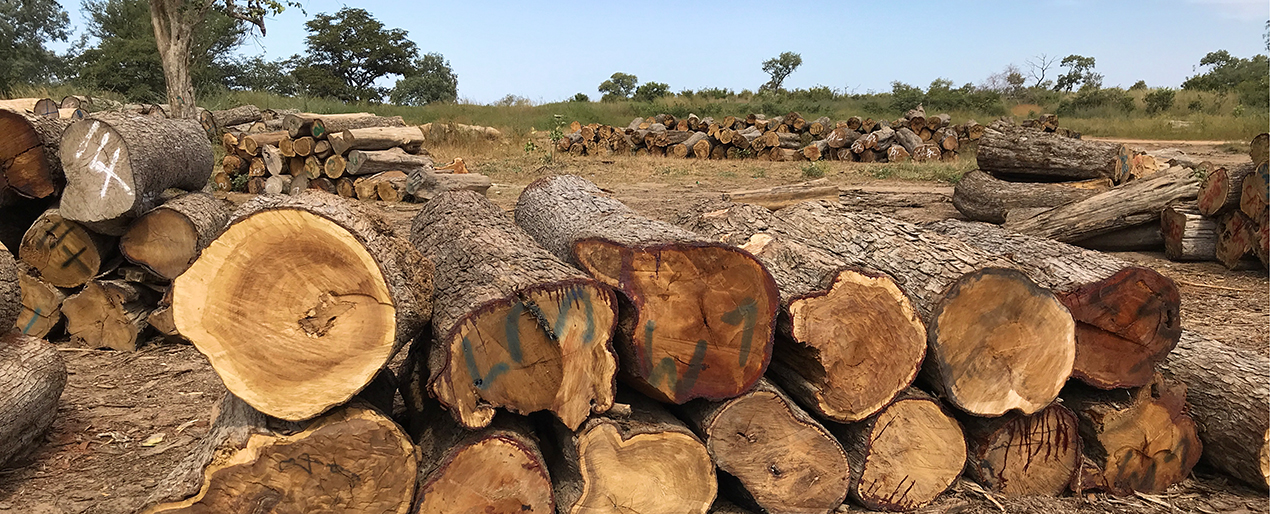
Between 2014 and 2017, The Gambia exported nearly 163 million US dollars-worth of rosewood, a rare and precious tree species, to China. During this time, Westwood, a Gambian company presumably owned by Swiss national Nicolae Bogdan Buzaianu and former Gambian President Jammeh, had the exclusive license to export rosewood. The timber it exported was illegally felled in neighboring Casamance where the separatist armed group has been fighting the Senegalese army for decades. TRIAL International filed a criminal complaint with the Swiss Office of the Attorney General against Mr. Buzaianu accusing him of having pillaged conflict timber.

The logs felled in the Senegalese region of Casamance were smuggled across the Gambian border and left in open depots before being sold to traders. ©TRIAL International

According to the criminal complaint (dénonciation pénale) filed by TRIAL International, Swiss businessman Nicolae Bogdan Buzaianu’s company was involved in the pillaging of precious rosewood from Casamance between 2014 and 2017. During this period, Westwood Company Ltd – which, according to TRIAL International’s findings, Mr. Buzaianu co-founded with former Gambian President Yahya Jammeh – had a monopoly on the export of rosewood, a precious tropical wood from The Gambia. But with Gambian rosewood nearly depleted since 2011, most of the timber was actually imported from Casamance, a region in southern Senegal that borders The Gambia. For several decades, large areas of this region have been under the control of the separatist armed group, the Mouvement des forces démocratiques de Casamance (MFDC).

“Exploiting natural resources from a conflict zone is a war crime that must be punished. Without the pillaging of natural resources, many armed groups would have no means of financing their wars’, said Montse Ferrer, Senior Legal Advisor and Corporate Accountability Coordinator at TRIAL International. ‘Despite numerous documented cases of pillage, not a single conviction has been made since the end of World War II.’”

TRIAL International filed a criminal complaint for pillage against Mr. Buzaianu in Switzerland with the Office of the Attorney General (OAG) in June 2019. ‘We have waited until today to go public because we wanted to give the Swiss prosecutorial authorities sufficient time to review the evidence and, as the case may be, take decisive action against Mr. Buzaianu. We are hopeful that these steps have been taken and that the OAG is investigating the matter’, she added.

LOGGING THAT BENEFITS AN ARMED GROUP

Some estimates suggest that Senegal loses the equivalent of 40,000 hectares of forest per year, several dozen hectares of which are lost due to the illegal exploitation of rosewood in Casamance. This selective deforestation has led to a decrease in rainfall and increased desertification in the region. It has also led to conflicts between rebels and communities who can no longer use the forests for sustainable livelihoods.

Illegal logging of precious woods is problematic, as it undermines reforestation efforts in the region. According to the International Institute for Environment and Development (IIED), “in the village of Koudioube, the restoration of the community forest has helped to overcome conflicts.” Illegal logging has stopped, fruits and wildlife are abundant, and local people are once again able to sell forest products. Communities that used to fight each other are now working together.

A large share of the trafficking and logging has been taking place directly in the territory controlled by the MFDC for almost thirty years. ‘Westwood’s illegal activity is all the more serious because it contributed to an illegal timber trade that has historically financed the MFDC. Equally striking is that this trade has had such a negative impact on the lives of local people contributing directly to the deforestation of the region’, said Jennifer Triscone, Legal Advisor at TRIAL International. The armed group exercises de facto control over the precious wood industry by issuing logging authorizations and transport permits, and by ensuring the security of the latter. The rebels also illegally exploit and sell precious hardwood timber to finance their armed struggle: an illegal trade fueled by demand from the global tropical hardwood market.


  Read the full press kit

The Swiss Federal Criminal Court (FCC) has overturned a decision of the Office of the Attorney General (OAG) to dismiss the case of former Algerian minister Khaled Nezzar, who is suspected of war crimes. In a landmark 50-page decision, the FCC rules that an armed conflict did exist in Algeria in the early 1990s and that General Nezzar was aware of the countless crimes committed under his command. Consequently, the case is referred back the OAG, who will have to resume the investigation.


Was there an armed conflict in Algeria before 1994? By answering in the negative in January 2017, the OAG had closed the investigation into General Khaled Nezzar, the former Algerian Minister of Defence, suspected of war crimes during his time in office. According to the OAG, without an armed conflict, there cannot be any war crimes; without war crimes, there cannot be any prosecution.

The FCC overruled the OAG. Following a detailed legal reasoning, it concluded that “the requirement of a non-international armed conflict in Algeria between January 1992 and January 1994 is fulfilled”. The Court judged that the crimes were indeed committed in the context of such a conflict, and that the former minister could therefore face charges of war crimes, and even potentially charges of crimes against humanity.

For Bénédict De Moerloose, Head of TRIAL International’s Investigations and Criminal Law Division, “this historic decision now forces the OAG to address the issue of Khaled Nezzar’s personal responsibility. Especially as the Court affirmed that he could not have ignored the abuses committed by his subordinates.”

Indeed, according to the FCC, “there is no doubt that [Khaled Nezzar] was aware of the acts committed under his orders”. Extrajudicial executions, enforced disappearances and acts of torture, the list of abuses is long. The description of some of these acts is chilling: beatings with sticks, wire and belts, nail pulling, cigarette burns, etc. According to the FCC, the widespread and systematic nature of such acts could qualify as crimes against humanity.

“The OAG’s arguments were fully dismissed,” according to Pierre Bayenet, one of the plaintiffs’ lawyers who appealed against the dismissal. “In five years of investigation and after hearing dozens of witnesses without ever raising the issue of the existence of an armed conflict, the decision to shut down the case was just incomprehensible.”

“It is an immense relief for the victims who finally see their suffering recognized,” said Damien Chervaz, the other lawyer defending the plaintiffs. “The OAG must now resume the investigation and quickly decide if Khaled Nezzar should stand trial.”


The Nezzar case at a glance

Khaled Nezzar was Minister of Defence and a member of the High Council of State in Algeria from 1992 to 1994. In October 2011, following the filing of a criminal complaint by TRIAL International, he was taken into custody and questioned in Switzerland. Khaled Nezzar was suspected of having authorized or incited his subordinates to commit acts of torture, murder, extrajudicial executions, enforced disappearances and other acts constituting war crimes. He was released in exchange of a promise to comply with subsequent court summons.


Context

The “Black Decade” in Algeria (1992-2002) is believed to have resulted in some 200,000 deaths or disappearances. Human rights violations were widespread in the country and the use of torture was systematic. As head of the army and de facto leader of the regime, Khaled Nezzar was in charge of troops who committed countless abuses. Those crimes were left unpunished. Nobody has ever been prosecuted in Algeria, let alone convicted for those crimes.


Chronology of the case

19 October 2011: Khaled Nezzar is reported to be present in Switzerland. TRIAL International files a criminal complaint with the Swiss Office of the Attorney General (OAG), which opens an investigation.

20 October 2011: Khaled Nezzar is taken into custody and questioned by the OAG until 21 October, before being released in exchange of the promise to participate in subsequent proceedings.

January 2012: Khaled Nezzar files an appeal against the opening of the investigation, arguing that his position as Minister of Defence at the time protected him from criminal prosecution in Switzerland.

31 July 2012: The Swiss Federal Criminal Court (FCC) issues a landmark decision following the appeal and rejects Khaled Nezzar’s claim, considering that immunity cannot be invoked for crimes under international law (war crimes, crimes against humanity or genocide).

2011 to 2016: Five victims file complaints and sixteen people are heard in the proceedings.

16 to 18 November 2016: The OAG hears Khaled Nezzar once again.

4 January 2017: The OAG dismisses the case.

16 January 2017: The plaintiffs file an appeal before the FCC against the dismissal order.

6 June 2018: The FCC overturns the decision of the OAG, which must now resume the investigation.