Joint bulletin – Making justice work in the Roger Lumbala trial
On 15 December 2025, the Paris cour d’assises found former politician and military leader Roger Lumbala guilty of complicity in crimes against humanity, committed in the Democratic Republic of Congo (DRC). The five weeks of hearings in the Lumbala trial featured 65 testimonies (including from 20+ Congolese survivors), 30 witnesses (including United Nations investigators, journalists and experts), and 35 civil parties (including civil society organisations, such as TRIAL International).
The verdict against Lumbala is historic as it challenges over two decades of impunity.
Lumbala is the first Congolese national to be tried before a national court for crimes against humanity committed during the Second Congo War (1998-2003), and this is the first universal jurisdiction case in France related to events in the DRC. By convicting Lumbala, the French court reaffirmed a fundamental principle: the gravest crimes know no borders.
The charges concerned acts of murder, torture, rape, sexual slavery, enslavement through forced labour, pillage and other inhuman acts committed against civilians. Many of the attacks were perpetrated in the Mambasa, Beni, Epulu, and Mandima regions (in the provinces of Ituri and North Kivu). This is a region heavily scarred by conflict, where most of the identified victims still live today.
“We were scared but came all the way here because the truth matters. For years, no one heard us. Today, the Court did. We would have preferred to face Roger Lumbala, to look him in the eyes. But this verdict marks a first step toward reclaiming pieces of ourselves that were taken from us.” –David Karamay Kasereka and Pisco Sirikivuya Paluku, survivors who testified during the Lumbala trial
Through community reporting, media engagement, and dialogue with survivors, Impunity Watch and TRIAL International sought to bridge the gap between a courtroom in Paris and communities in eastern DRC. We collaborated to improve access to information for Congolese communities affected by the crimes judged in the Lumbala trial.
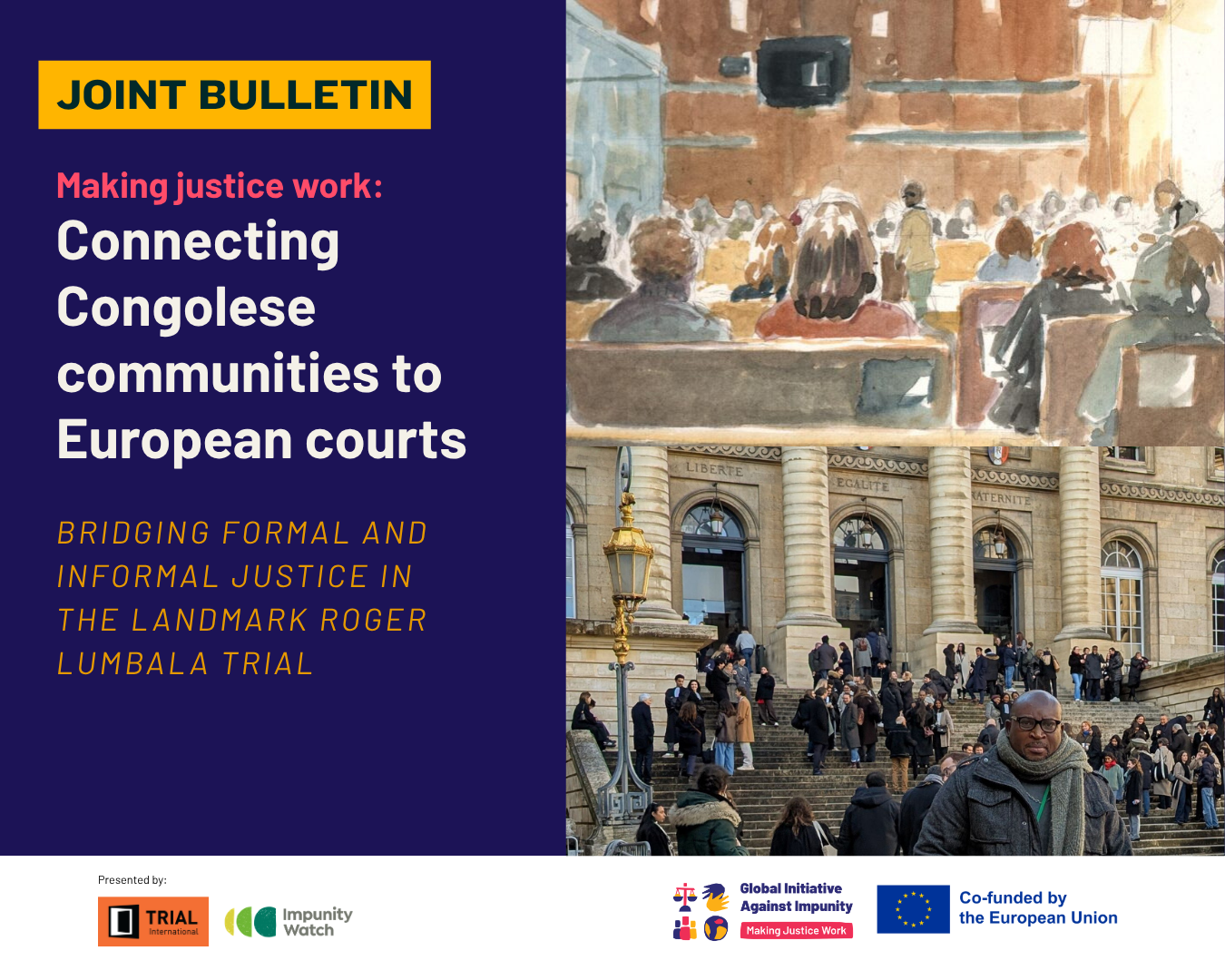
In this joint bulletin, explore reflections from survivors and affected Congolese communities, and lessons we have learned on the importance of bridging formal and informal justice in order to ‘make justice work’.
Click on the joint bulletin just below to read it in full.
The joint bulletin, support for the trial and the community reporting process came from the Global Initiative Against Impunity, an EU-funded consortium of civil society organisations. Find out more.