
Case

Following a day of hearings at the Cantonal Court of St Gallen, Yuri Harauski’s appeal trial has now concluded.
At the start of the trial, the Court ruled on the issues intended to clarify the course of the proceedings and, in particular, held that the complainants could not be recognised as parties to the case in relation to the disappearance of Viktor Gonchar, as they were not close relatives of the missing person. It refused to allow the complainants to address the court, on the grounds that their testimony would not provide any additional evidence capable of establishing the truth.
The Court rejected the complainants’ submission of an expert report, which was intended to place the defendant’s statements within a specific historical context. According to the Court, the information it contained could not be regarded as admissible evidence.
When questioned about the charges against him, Yuri Harauski explained, amongst other things, that he had joined the army in 1996 and had served in Unit 3214. The SOBR had been established in 1998 and he had been active within it until he was imprisoned in Belarus. In this context, he stated that he had received training on the tactics to be used when abducting individuals. In his own words, he had ‘abducted and liquidated’ the three missing persons. The orders to carry out the abductions came from Lukashenko and were relayed by Pavlichenko, all verbally. He had told the truth to the Swiss asylum authorities, to the prosecutor and before the Court of First Instance.
Highlighting, in particular, the serious difficulties arising from inadequate interpretation during the trial at first instance, which had compromised the decision of the first judges, the representative of the plaintiffs and the Public Prosecutor’s Office argued for a guilty verdict and, respectively, emphasised the credibility of the accused in relation to his involvement in the enforced disappearances of Yury Zakharenka and Anatoly Krasouski in 1999.
The defence, for its part, argued in favour of upholding the acquittal handed down at first instance, on the grounds that the constituent elements of the offence of enforced disappearance within the meaning of Article 185bis of the Criminal Code had not, in any event, been met, and that the provision was too vague to be applied.
Yuri Harauski did not wish to make any further comments following the closing arguments.
The verdict will be delivered orally at a later date, likely in October 2026. The exact date will be communicated to the parties.
The oral reading of the decision and the grounds for it will be open to the public, and a press release will be issued by the Court.
The appeal trial of Yuri Harauski will take place on 22 September 2026 in St. Gallen. More information can be found on the website of the Cantonal court. (in German) Representatives of TRIAL International, FIDH and Viasna will be present.
This time, translation between German and Russian will be provided by the court. However, the space in the courtroom is limited. If you would like to attend, please register on the dedicated page on the court’s website.
Yuri Harauski’s appeal trial, initially scheduled to take place on 24 June 2026 in St Gallen, has been postponed. As soon as the new date will be communicated, it will be announced here.
Accountability for Enforced Disappearances in Belarus: Appeal Against Acquittal of Former Member of Lukashenka’s Hit Squad to Take Place in Switzerland
The appeal trial of Yuri Harauski, a former member of SOBR, a special police force under President Aliaksandr Lukashenka, will take place on 24 June 2026 in St. Gallen, Switzerland. Harauski is accused of participating in the enforced disappearances of three political opponents in Belarus in 1999, to which he confessed.
Read our frequently asked questions on the appeal trial of Yuri Harauski, former member of President Aliaksandr Lukashenka’s elite hit squad SOBR, here.
The appeal trial of Yuri Harauski, former member of a Belarussian elite unit, for his participation in the enforced disappearances of three opponents of the regime, will take place on 24 June 2026 in St. Gallen, Switzerland.
The appeal trial of Yuri Harauski will take place on 24 June 2026 in St. Gallen, Switzerland.
Despite Harauski’s public confession, giving details about the kidnappings and killings, he was acquitted in September 2023, after a 2-day trial. While it recognised the responsibility of the regime in the crimes, the court found that the evidence before it did not establish his individual participation in the crimes beyond reasonable doubt.
His appeal trial will take place on 24 June 2026 in St. Gallen, at which new evidence is expected to be presented. The two relatives of the victims who had filed criminal complaints against Yuri Harauski in 2021, together with representatives of TRIAL International, the International Federation for Human Rights (FIDH) and the Human Rights Center Viasna, will be present at the hearings.
More information can be found on the website of the cantonal court.
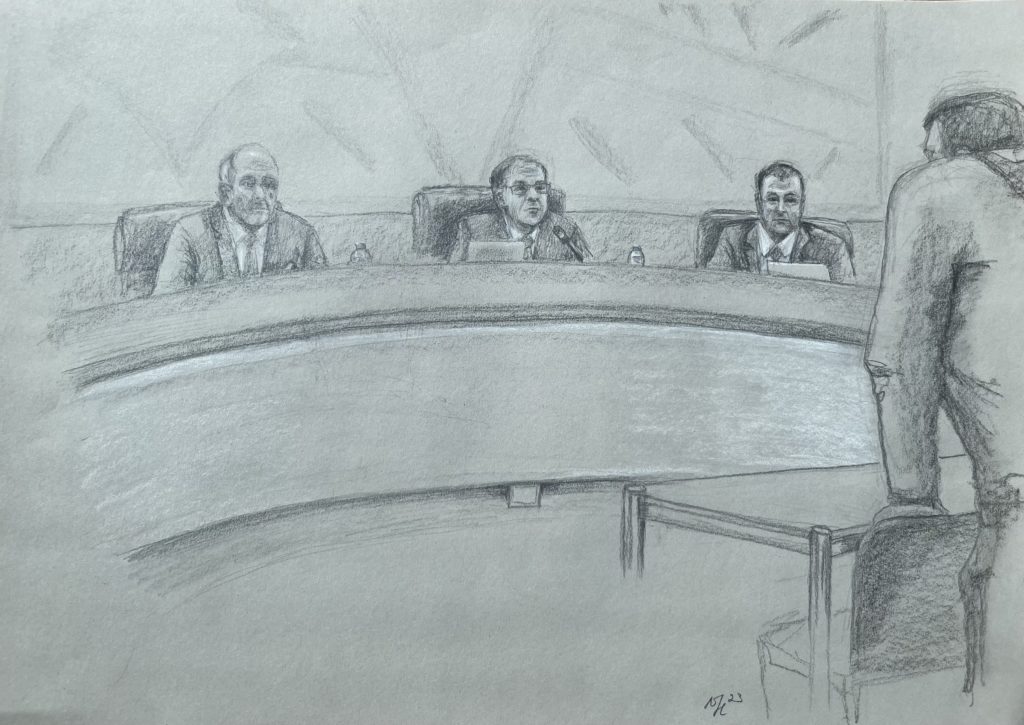
Yuri Harauski has been acquitted of the crime of enforced disappearance of three political opponents in 1999 in Belarus. While the Court recognised the responsibility of the regime in the crimes, the judges were not convinced of the involvement of the defendant in the events. The families of the victims remain in a state of uncertainty about the exact circumstances of their loved ones’ disappearances. TRIAL International, FIDH and Viasna regret today’s verdict and will continue to support the victims in their quest for justice, including during the appeal process.


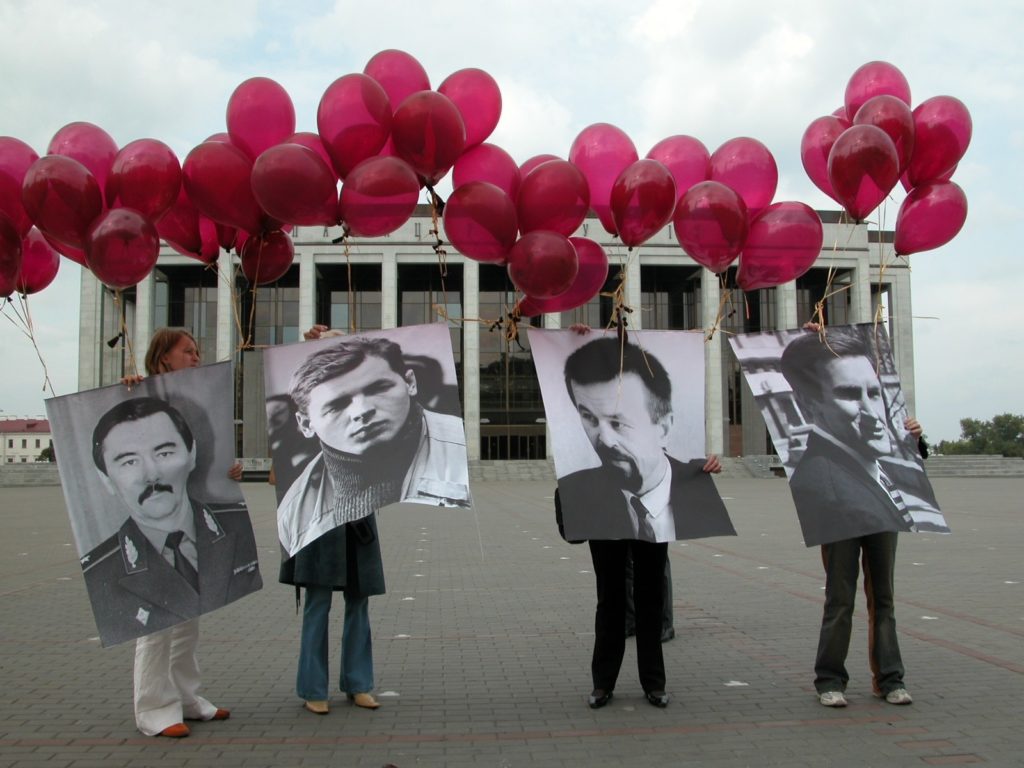
Yuri Harauski, former member of President Aliaksandr Lukashenka’s SOBR unit will stand before a criminal court in St. Gallen, Switzerland on 19-20 September 2023. He is accused of having participated in the enforced disappearances of three major political opponents in 1999. The proceeding follows the criminal claims by relatives of two of the victims and is supported by FIDH, TRIAL International and Viasna, which concurrently filed a criminal complaint.
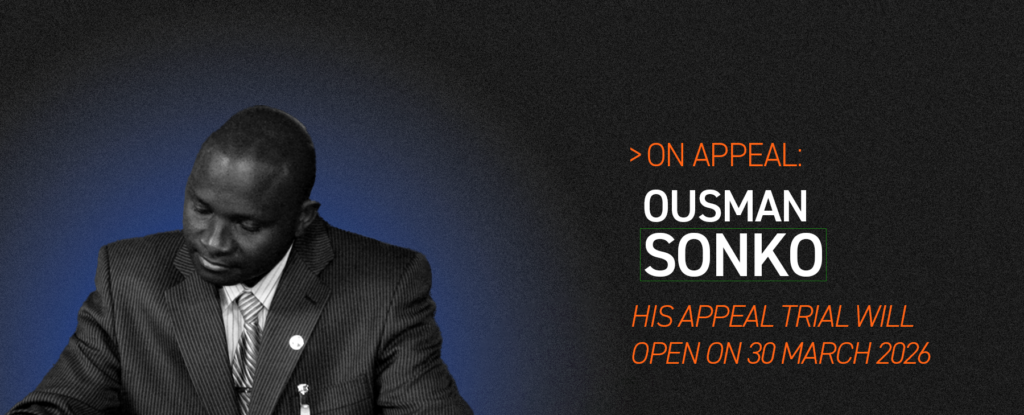
Ousman Sonko was The Gambia’s Minister of Interior in 2006-2016, during the dictatorship of Yahya Jammeh. TRIAL International filed a criminal complaint against him in 2017 in Switzerland. His trial took place in 2024. The FCC sentenced him to 20 years in prison for crimes against humanity on 15 May 2024. He is the highest-ranking official tried for international crimes under UJ in Europe. His appeal trial took place from 30 March to 16 April 2026. The verdict will be read at a later date.
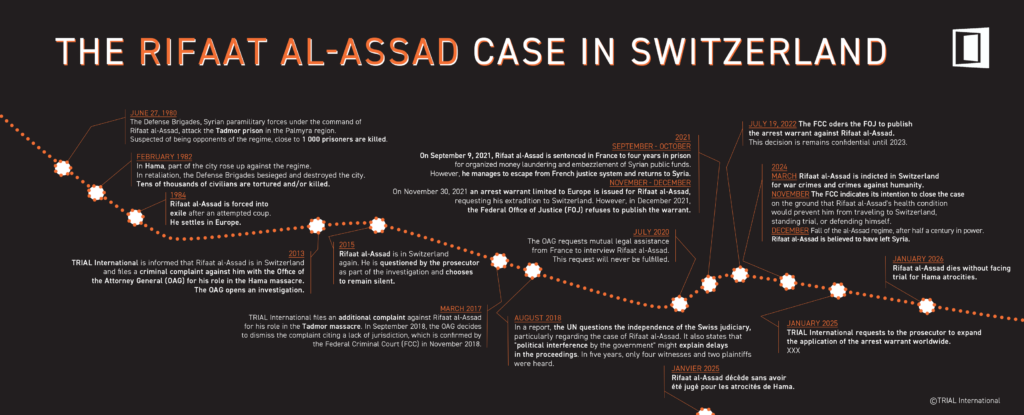
Rifaat al-Assad, uncle of ousted president Bashar al-Assad, has been under investigation in Switzerland since 2013 for his alleged role in the massacre of the Syrian city of Hama in February 1982 by the “Defense brigades”, he was commanding at the time. The OAG indicted him in March 2024 for war crimes and crimes against humanity. Following Rifaat al-Assad’s death on 20 January 2026, at the age of 88, the FCC closed the case.
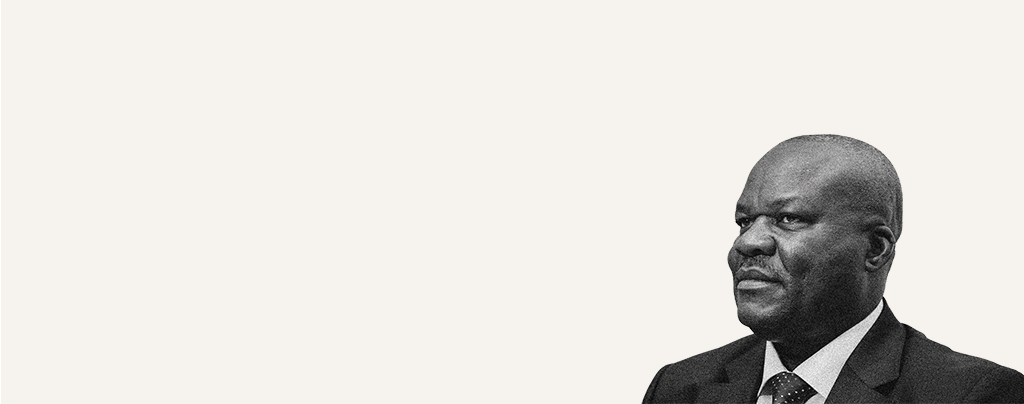
Roger Lumbala Tshitenga is the former leader of the non-state armed group “Congolese Rally for National Democracy” (RCD-N). He was arrested in 2020 in Paris and indicted in 2023 for his alleged complicity in and conspiracy to commit crimes against humanity, namely murder, torture, rape, pillage and enslavement, including sexual slavery, in the provinces of North Kivu and Ituri in the Democratic Republic of the Congo (DRC) between 2002 and 2003. His trial took place at the end of 2025 in Paris.
Bai Lowe, former member of the “Junglers” death squad of former Gambian President Yahya Jammeh, was sentenced to life in prison on 30 November 2023 in Germany for crimes against humanity. His conviction was confirmed by the Federal Court of Justice on 29 November 2024. It was the first trial held under universal jurisdiction for crimes committed in The Gambia during the Jammeh era.

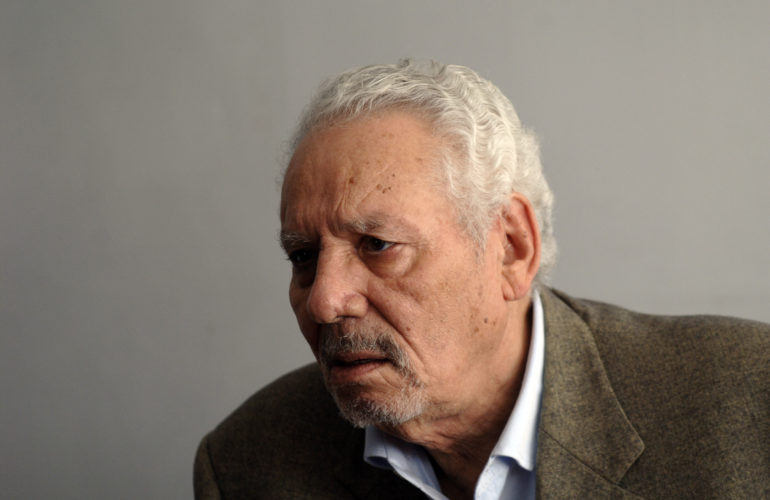
Khaled Nezzar, former Algerian Minister of Defence, was arrested in Geneva in 2011, following a denunciation by TRIAL International. He was indicted for war crimes in August 2023, but died in December 2023. His trial had been scheduled to take place in June-July 2024. In March 2025, the Complaints Court of the FCC rejected the request of two plaintiffs for the recognition of a denial of justice. As a consequence, they lodged a complaint with the European Court of Human Rights, which declared it inadmissible on 16 October 2025.
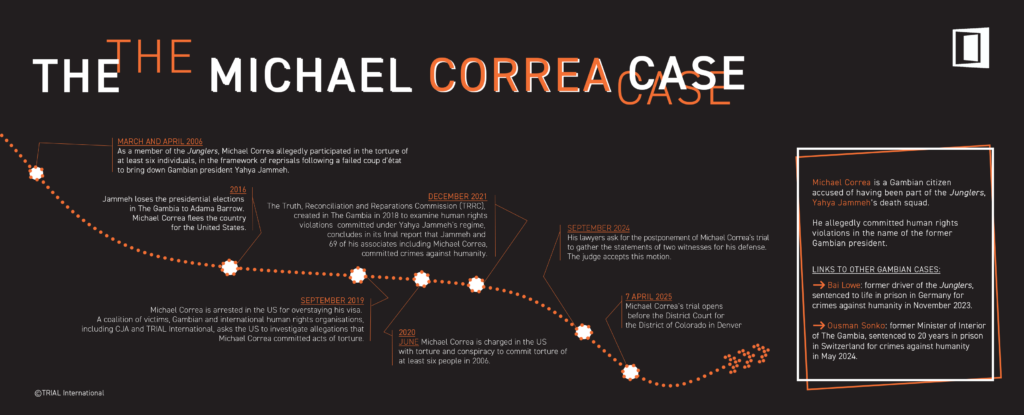
Michael Correa was a member of the “Junglers” death squad of former Gambian President Jammeh. In 2020 he was charged with torture and conspiracy to commit torture of at least six people in 2006. His trial took place in April 2025 in Denver. For the first time, a US jury found a non-US citizen guilty for torture committed abroad. He is the third person tried under universal jurisdiction for crimes committed under Jammeh’s regime. The jury found him guilty of all counts and on 22 August 2025 the judge sentenced him to 810 months, or 67.5 years, in prison.
Kwenga Omari, alias Donat, is a Congolese national and former leader of a Raia Mutomboki militia accused of crimes against humanity, allegedly committed in the territories of Shabunda and Kalehe in the East of the Democratic Republic of the Congo (DRC) between 2017 and 2021.

On May 20, the trial of a dozen militiamen, local politicians and representatives of the Congolese security forces for war crimes and crimes against humanity committed in the Kamonia territory between 2017 and 2018 opened in Tshikapa (Kasai province, Democratic Republic of Congo).