
Geneva, 18 January 2017 – The case against Khaled Nezzar was opened by the Office of the Attorney General (MPC) of Switzerland in 2011 for alleged war crimes. Five years later, however, the MPC concluded against all expectations that the alleged acts by the former Minister of Defense could not be considered as war crimes on the grounds that there was no war in Algeria when the facts occurred. TRIAL International, the NGO that filed a criminal complaint with Swiss authorities against Khaled Nezzar, believes this ruling is incomprehensible and supports the civil parties in their appeal before the Swiss Federal Criminal Court.

It took the arrest of the accused, several years of proceedings and numerous hearings of witnesses and victims for the MPC to consider that the classification of the crime did not, in the end, justify holding a judgment. A decision by the Federal Criminal Court (TPF) could, however, reset the case in motion.

We have filed an appeal before the Federal Criminal Court in Bellinzone. It is indeed incomprehensible that the MPC has investigated for five years, questioned some fifteen witnesses and even went so far as to send an International Letter Rogatory to Algeria without ever questioning the existence of an armed conflict, before abruptly concluding that that was not the case”, says Pierre Bayenet, one of the civil parties’ attorney-at-law contacted by TRIAL International.

According to the NGO, ample evidence indicates that the numerous acts of torture reported by the victims were indeed committed by the army as part of a particularly deadly armed conflict. “The “Black Decade” has resulted in 200,000 casualties and many sources illustrate the intensity of the combats between armed groups and the Algerian army after the coup d’état. In spite of that, there is a quasi-total impunity for these facts. It is high time this changes”, says Philip Grant, Director of TRIAL International.

Civil parties agree with this view: “The reason why the case was dismissed is an insult to victims who were tortured during the dirty war. They have experienced that war in their flesh and denying its existence is a new form of violence towards them”, says Damien Chervaz, another attorney-at-law for the civil parties.

TRIAL International supports their appeal and hopes that the TPF confirms the existence of an armed conflict in Algeria at the time of the events. It will then be incumbent upon the MPC to rule on the charges against Khaled Nezzar for numerous acts of torture.

____

THE NEZZAR CASE AT A GLANCE

Khaled Nezzar was Minister of Defense and President of the High Council of State in Algeria from 1992 to 1994. In October 2011, following a criminal complaint filed by TRIAL International, he was taken into custody in Switzerland for having authorized or incited his subordinates to commit acts of torture, murder, extrajudicial executions, enforced disappearances and other acts constituting war crimes. He was released in exchange for promising to participate in subsequent proceedings.

BACKGROUND INFORMATION

The “Black Decade” in Algeria (1992-2002) caused between 60,000 and 200,000 deaths or disappearances. Human rights violations were widespread in the country and the use of torture was systematic. As head of the army and Number 1 in the regime, Khaled Nezzar could not have been unaware of his troops’ actions. The impunity for these events is total. Nobody has ever been prosecuted, let alone sentenced, for these crimes in Algeria.

FACTS AND EVIDENCE

The evidence against the accused includes testimonies of victims and witnesses, among whom former members of the security forces calling him directly into question; reports from NGOs, the United Nations and the United States Department of State, stating the systematic practice of torture and other crimes committed by the regime.

CHRONOLOGY OF THE CASE

19 October 2011: Khaled Nezzar is reported to be present in Switzerland. In accordance with its mandate, TRIAL International files a criminal complaint with the Swiss Office of the Attorney General (MPC), which opens an investigation.

20 October 2011: Khaled Nezzar is taken into custody and questioned by the MPC until 21 October, before being released in exchange for promising to participate in subsequent proceedings.

 January 2012: Khaled Nezzar files an appeal against the prosecution of his case, arguing that his position as Minister of Defense at the time protected him from criminal prosecution in Switzerland.

July 2012: The Swiss Federal Criminal Court makes a historical decision following the appeal and rejects Khaled Nezzar’s claim, considering that immunity could not be invoked for international crimes (war crimes, crimes against humanity or genocide).

13 August 2014: The MPC sends a draft of an International Letter Rogatory to the Federal Office of Justice, but it was not forwarded to the Algerian authorities until 7 April 2015.

 2011 to 2016: Five victims file a complaint and sixteen persons are heard in the proceedings.

 November 2016: The MPC hears Khaled Nezzar once again.

January 2017: The MPC dismisses the case.

18 January 2017: The civil parties announce they will appeal the decision before the Federal Criminal Court.
Lack of identity protection for victims filing compensation claims poses serious threats to their security and well-being. Last month, TRIAL International stepped up its advocacy efforts in favor of better protection.

Identity protection in criminal proceedings is crucial to prevent retaliation against victims speaking up, but also to protect them from additional trauma and isolation. It is particularly important for vulnerable groups, such as sexual violence survivors, who already face acute social, economic, and psychological hurdles when seeking justice.

While victims are guaranteed identity protection in war crimes cases, they are all too often redirected to civil proceedings to claim reparation – where no law protects their anonymity. As a consequence, many victims give up their claims altogether.

Throughout the month of May, TRIAL International has focused its advocacy efforts on this issue. Its Sarajevo-based team has met with national legal experts, including Ombudswoman for Human Rights Jasminka Džumhur and Supreme Court judge Goran Nezirović. Together, they will work to facilitate the reform of civil and enforcement proceedings, offering better protection to the tens of thousands of victims still awaiting justice.

W. G. was a senior officer of the Afghan army and belonged to both the Presidential Guard and the Kabul Garrison (KHAD – the security and intelligence agency). In his 15 years of service, he particularly fought the Mujahideen and was involved in the arrest of prisoners of war. Several NGOs accused KHAD of systematically using torture.

On June 16, 2005, the Swiss Asylum Appeal Commission (ARK) decided that W.G. should be excluded from refugee status on the grounds of his potential involvement in war crimes and crimes against humanity. In view of the fact that he could potentially become a victim of persecution in Afghanistan, W. G. was nevertheless granted entry into Swiss territory on a temporary basis.

On December 8, 2006, TRIAL International filed a criminal report of war crimes and crimes against humanity allegedly committed by him before the Swiss Office of the Armed Forces Attorney General / Military Justice, which at that time had jurisdiction to prosecute war crimes.

After ordering an in-depth investigation, the military justice system reached the conclusion that the suspect was not the man he claimed to be. He had usurped the rank, the position and possibly the identity of a senior officer of the Afghan intelligence services in the Communist period in order to try to obtain asylum in Switzerland. The case was therefore closed on March 17, 2010.


In March 2011, TRIAL International and the Palestinian NGO Al-Haq supported six Palestinian families with their filing of a complaint of war crimes against the Swiss subsidiary of Caterpillar, the manufacturer of construction site machinery. The reason for doing so was that the Israeli army had used D9 bulldozers made by the same manufacturer to destroy their homes without any military need in August 2007, during a raid on a neighborhood in the town of Qalqilya (West Bank).

On February 24, 2014, the Office of the Attorney General of Switzerland refused to pursue the complaint on the grounds that the bulldozers in question were not weapons and that the company Caterpillar could not be held responsible for the use that their buyers made of their equipment.

TRIAL International deplored the closure of this case, but welcomed the fact that the prosecutor described the events that happened in Qalqilya in 2007 as “punitive demolitions”, that is to say, war crimes committed by the Israeli army.


After several missions in Colombia, and in conjunction with the Colombian NGO Fundación Comité de Solidaridad con los Presos Políticos, TRIAL International managed to trace a former member of a Colombian paramilitary group called United Self-Defense Forces of Colombia (AUC), who may have been involved in the execution of numerous students and lecturers at the University of Barranquilla. Indeed, C. P. might have used his position as a trade unionist at the university to indicate “military targets” to AUC’s killers. Based on the considerable amount of evidence gathered, a criminal report was filed in January 2013, as was a criminal complaint on behalf of a woman and the son of a university lecturer murdered in front of their very eyes.

Based on these, a criminal investigation was opened by the Swiss Federal Prosecutor. These proceedings could have led to the first judgment in respect of war crimes for a member of a paramilitary group outside Colombia. However, the case was closed unexpectedly following the death of the accused.

This precedent nevertheless injected renewed impetus into the investigation in Colombia, which led to several arrests and arrest warrants.


In partnership with the NGOs Open Society Justice Initiative and Conflict Awareness Project, TRIAL International, filed a report against Argor-Heraeus SA before the Office of the Attorney General of Switzerland in November 2013. That company was accused of refining nearly three tonnes of gold pillaged by rebels in the north of the Democratic Republic of the Congo (DRC) between 2004 and 2005.

What followed on from this was the opening of an investigation of Argor for war crimes and aggravated money laundering, a search and seizure operation, and a civil society campaign against the pillage of precious metals in times of armed conflict. By rejecting the appeal lodged by the Swiss company against the investigation and the search, the Federal Criminal Court agreed with TRIAL International’s report, thus underscoring the importance of the evidence provided by the NGO.

After an investigation lasting for nearly 18 months, on March 10, 2015, the Office of the Attorney General of Switzerland ordered the case to be closed, finding that there was no evidence of the company knowing that it had been refining gold of illegal provenance. The Office of the Attorney General of Switzerland did find, however, that gold had been pillaged from DRC by rebels and that the company had breached its anti-money laundering obligations. This very controversial decision also highlighted the shortcomings of Swiss legislation, which did not allow such acts to be prevented or punished.

Regardless of the outcome, the Argor-Heraeus SA case represents a considerable step forward and highlights the problem of raw material pillage by western companies. It was also the first criminal investigation opened for pillage within a context of armed conflict since the cases resulting from the Second World War.

In parallel to this case, Argor’s commercial partner company, the British company Hussar Ltd, was reported for the same acts to the Metropolitan Police in London. The investigation is ongoing.


In 1992, Lejla B. (assumed name) left her hometown of Zivinice to join her 19-years old son in Bosanski Samac. Upon arrival, she found that the Army of the Republika Srpska was occupying the town. They had sent her son to a forced labor camp where he was eventually shot on 3 July 1992. On the week of her son’s death, Lejla B. was arrested by three policemen and taken herself to the Zasavica forced labor camp. Lejla B. stayed there for 10 months, under inhumane conditions and forced labor. On three occasions she was raped by a member of the Ministry of Internal Affairs of the Republika Srpska.

After years of silence suffering, Lejla B. found the strength to demand justice in 2007, but the authorities took no subsequent action. TRIAL International offered her its support in 2010, pushing the authorities to open an investigation and to prosecute the perpetrator.

Finally, in 2013, the trial of Dragoljub Kojic started before the Doboj Court. The Court found him guilty of rape and war crimes against civilian population and sentenced him to a three-year prison sentence. In November 2013, the Supreme Court of Republika Srpska confirmed this verdict. The Doboj Court declined, however, to grant the victim compensation and referred her back to a civil court.

TRIAL International also assists victims to claim compensation in civil procedures but highlights, however, that further proceedings can be straining on the victims’ psyche and budget. The NGO advocates for the inclusion of compensation claims directly in the criminal proceedings.


Ana B. (assumed name) was fourteen years old when she was raped by soldiers of the Army of Republika Srpska in Kotor Varos (Bosnia & Herzegovina) in 1992. Although Ana B. and her family reported the crime immediately and were heard by the authorities, the case stalled for 20 years.

Investigation

In 2012, TRIAL International took up the case and pressured the authorities of BiH to prosecute the perpetrators. The Prosecutor’s Office finally indicted against Bosiljko Markovic and Ostoja Markovic in April 2014, for war crimes against civilians.


Procedure

The trial started in September 2014, during which several witnesses testified. Ana B.’s mother and brother gave a moving testimony of how they were unable to help her when she was raped. Both of them went through the whole procedure as protected witnesses.

In June 2015, the Court of BiH delivered its judgment, finding the accused guilty of war crimes and sentencing them to ten years imprisonment each. The defense lawyers have appealed sentence and a final decision by the Appeals Chamber is underway.


Outcome

For the first time in Bosnian criminal proceedings, the Court also decided to redress a victim of war crimes: the accused were condemned to pay her a 26 500 KM fine. This outcome is a significant step towards positive court practice regarding victims’ reparation. Compensation claims decided in criminal proceedings save victims additional processes before civil courts, which often burden them with further trauma and costs.

Ana B. concluded: “My fight for justice would not have been possible without TRIAL’s engagement and support. During our exchanges, I felt the honesty of the relationship. This means a lot to me. I am satisfied with the verdict, it proves that justice is within reach and that war crimes cannot be outdated.”


A key ruling by the Swiss Federal Criminal Court has given momentum to a war crimes case against the Swiss gold refining giant, Argor-Heraeus SA, alleged to have laundered millions of dollars of looted gold from the Democratic Republic of the Congo.

The three NGOs behind the Stop Pillage Campaign, the Conflict Awareness Project, Open Society Justice Initiative, and TRIAL, call on the UK and Jersey Channel Island authorities to follow suit and swiftly investigate the two British firms which were the primary traders of the gold at issue in the case.

To date, the London-based Hussar Services Limited and the Jersey Channel Island-based Hussar Limited, as well as their corporate directors, have evaded accountability for their central role in the lucrative transnational “blood gold” enterprise alleged in the complaint in Switzerland.

The Swiss court ruling from 24 January 2014 upheld the right of the prosecutor to search the premises of Argor-Heraeus SA and seize documents and computers. Stating that the strength of the evidence warranted such an action, the court rejected Argor’s subsequent legal challenge to the prosecutor’s right to conduct the search.

This decision corroborates what we have always believed: that very serious suspicions weigh on Argor-Heraeus SA. This decision will now allow the authorities to continue the investigation, the results of which we will await with great interest,” said Bénédict De Moerloose, lawyer in charge of the case at TRIAL.

Until governments such as the UK and Jersey Channel Islands start to hold their own firms and businesspersons criminally liable for the pillage of Congo’s natural resources, war profiteers who aid and abet atrocities and human suffering will continue with impunity,” said Kathi Lynn Austin, Executive Director of the Conflict Awareness Project.

The same evidence that prompted the Swiss Prosecutor in charge of war crimes to open a criminal investigation against Argor-Heraeus SA has been made available to the UK and Jersey Channel Island authorities. Kathi Lynn Austin of the Conflict Awareness Project conducted the investigation over a nine-year period while the Open Society Justice Initiative provided the blueprint for reviving the prosecution of pillage.

We are heartened by the seriousness with which the Swiss authorities are pursuing the case as exemplified by this recent court ruling.  We urge UK and Jersey Channel Island law enforcement authorities also to pursue their investigation into the matter as rapidly as possible and, if warranted, prosecute those they conclude to be guilty of these war crimes,” said Ken Hurwitz of the Open Society Justice Initiative.

The Swiss court ruling from 24 January 2014 upheld the right of the prosecutor to search the premises of Argor-Heraeus SA and seize documents and computers -which the federal police did on 4 November 2013.

Stating that the strength of the evidence warranted such an action, the court rejected Argor’s subsequent legal challenge to the prosecutor’s right to conduct the search.

The decision of the Swiss Federal Criminal Court corroborates what we have always believed: that very serious suspicions weigh on Argor-Heraeus SA. This decision will now allow the authorities to continue the investigation, the results of which we will await with great interest,” said Bénédict De Moerloose, lawyer in charge of the case at TRIAL.

The Swiss case is a milestone for international justice: for the first time since the immediate aftermath of WWII a corporation could be judged for complicity in the war crime of pillage.

For more information:

  • Stop Pillage Campaign website
  • About the Swiss legal complaint filed by TRIAL
  • CAP’s report on the Pillage of Congo Gold: A Case for the Prosecution of Corporate Crimes
  • OSJI’s publication on Corporate War Crimes: Prosecuting the Pillage of Natural Resources

The Swiss Federal Criminal Court (FCC) rendered a decision on the Argor case on January 24, 2014. It reveals that a search was conducted on the premises of the Swiss refining company on November 4, 2013, following the opening of proceedings on alleged aggravated money laundry and complicity in the looting of raw materials. Documentation and computers were seized on this occasion by the federal police.


” The decision of the FCC corroborates with what we have always believed : very serious suspicions weigh on Argor-Heraeus SA. This decision will now allow the authorities to continue the investigation, the results of which we will wait with great interest ” said Bénédict De Moerloose, lawyer in charge of the case at TRIAL.

Argor-Heraeus SA had appealed against this search, refuting the allegations against them. But the FCC considered fully justified the measures taken by the prosecuting authority (search and seizure), given the importance of the evidence provided by TRIAL.

The decision of the FCC also shows that Argor-Heraus SA has never been cleared by any authority, despite what the company has continued to claim.

Argor-Heraeus SA was denounced by TRIAL last November for having refined nearly three tonnes of gold, pillaged by an armed group during the war in the Democratic Republic of Congo.

Following this complaint, the Federal Prosecutor in charge of war crimes cases opened a criminal investigation against the company for aggravated money laundry and complicity in war crimes.


For more information:

WWW.STOP-PILLAGE.ORG

TRIAL and its partners Open Society Justice Initiative and Conflict Awareness Project welcome the decision of the Swiss Federal Prosecutor to open a criminal investigation into the activities of the Swiss refinery company Argor-Heraeus SA for laundering of looted gold and complicity in war crimes.

This decision follows the filing of a denunciation against the Swiss company, by the NGO TRIAL (Track Impunity Always) on 1 November 2013. The Swiss association against impunity along with Open Society Justice Initiative and Conflict Awareness Project welcomes the opening of the criminal investigation by the Swiss Federal Prosecutor.

The opening of the investigation is a strong signal to corporations fueling war. Countries at war are not law-free zones and impunity is no longer ensured to those who break the law. The private sector can also be held accountable “, said Philip Grant, Director of TRIAL.

The Conflict Awareness Project is pleased that the Swiss Prosecutor is investigating Argor for criminal charges. For far too long, Argor has claimed that it was exonerated by the United Nations for its criminal involvement in the pillage of gold from Congo, which is not the case. The forensic evidence leaves no doubt that Argor was refining gold supplied by unlawful armed groups in the DRC “, said Kathi Lynn Austin, Executive Director of the Conflict Awareness Project.

The Swiss Federal Prosecutor’s decision appears to be the first effort to hold corporate actors accountable for pillage and related offenses since the Second World War. This case goes far beyond Switzerland to the international commodity and financial markets. Companies who choose to trade directly or indirectly with unlawful armed groups must understand that they risk prosecution for the war crime of pillage “, said Kenneth Hurwitz, Senior Legal Adviser at Open Society Justice Initiative.

The three NGOs now await the result of the investigation with trust and great interest.

WWW.STOP-PILLAGE.ORG


TRIAL (Track Impunity Always) has submitted to the Swiss Federal Prosecutor a criminal denunciation against the precious metals refinery Argor-Heraeus SA. The Swiss anti-impunity NGO holds information suggesting that the company may have laundered pillaged gold. The investigation and the evidence gathered indicate that between 2004 and 2005, Argor-Heraeus SA may have refined almost 3 tons of gold that had been pillaged in the Democratic Republic of the Congo (DRC) by an unlawful armed group that financed its operations by trafficking in gold. According to TRIAL, the refinery knew or should have assumed that the gold resulted from pillage, a war crime. TRIAL therefore requests law enforcement authorities to open an investigation and to establish whether an offense has been committed, and if so, to sanction the company.

On 1 November 2013, TRIAL filed a complaint (dénonciation pénale) to the Swiss Federal Prosecutor supported by extensive evidence against the Swiss precious metals refinery Argor-Heraeus SA. The Swiss anti-impunity NGO suspects that the refinery may have committed « aggravated laundering » (under article 305bis of the Swiss Penal Code) when it allegedly refined pillaged gold from the DRC, the sale of which contributed to financing the operations of an unlawful armed group in a brutal conflict.

The complaint follows investigations into the DRC-sourced gold supply chain that were conducted in the years 2004-2005 by the United Nations Group of Experts on the Democratic Republic of the Congo, pursuant to its mandate to monitor the arms embargo on the country. All of the African businesses and businessmen implicated in this affair were severely sanctioned by the UN Security Council, while Western businesses and businessmen were not, notwithstanding recommendations from the Group of Experts that all participants in the illegal supply chain be sanctioned.

For Philip Grant, Director of TRIAL : « It is unacceptable that pillaged raw materials that are feeding violence in a brutal and horrific war should be refined and prepared for marketing in Switzerland, with total impunity. These practices run contrary to law, but without a clear signal from law enforcement authorities, they will continue. This complaint should serve as a reminder that corporations are subject to the law and must also be held accountable. »

In light of the evidence obtained up to 2012 by Kathi Lynn Austin – former investigator in the UN Group of Experts – TRIAL believes that Argor-Heraeus SA could not have been unaware of the criminal origin of the gold.

Accordingly, in refining almost 3 tons of gold pillaged from the DRC in less than a year, Argor Heraeus SA may have committed aggravated money laundering. « Even if Argor-Heraeus SA was able at the time to escape UN sanctions under the embargo, that does not mean that it did not violate Swiss law », said Bénédict De Moerloose, TRIAL’s lawyer in charge of the case.

Bénédict De Moerloose added : « For a long time we have been investigating the activities of Argor-Heraeus SA during the years 2004-2005, with regard to Swiss law, in particular, money laundering. Today, thanks to newly obtained evidence, our suspicions are sufficiently well grounded for us to refer the matter to the international criminal law department of the Federal Prosecutor’s office. It is now for them to determine if Argor-Heraeus SA should be criminally prosecuted for the alleged conduct. »


The Stop-Pillage Campaign

Supported by the joint forces of three NGOs dedicated to the struggle against impunity – TRIAL, Conflict Awareness Project (the NGO started by Kathi Lynn Austin), and the Open Society Justice Initiative – a broader campaign started in parallel of the filing of the complaint.

The Stop-Pillage Campaign seeks to raise public awareness in Switzerland and abroad regarding the impact of the pillaging of raw materials, its link to armed conflict, and the responsibility of all actors in the supply chain. The NGOs call for a judicial response to this problem targeting every link in the chain, no matter in which country.


www.stop-pillage.org 


Case Summary

The Front des Nationalistes et Intégrationnistes (FNI) is an unlawful armed group that began operating in 2002 in northeastern DRC, seizing control of the city of Mongbwalu (Ituri) and of a gold concession named « Concession 40 ».

In violation of the embargo imposed by the UN Security Council in 2003, the FNI exploited this concession to finance its operations and buy arms. The FNI is widely accused of massacres, systematic violence against the civilian population of Ituri, sexual violence, pillage, and recruiting child soldiers.

With the collaboration and air transport provided by a local businessman, Dr. Kisoni Kambale, a large portion of the gold was sold in Uganda to a company called Ugandan Commercial Impex Ltd. (UCI).

This company resold the gold, in turn, to a buyer named Hussar Limited, a Jersey, Channel Islands company, and its London affiliate, Hussar Services Limited, which asked the Swiss company Argor-Heraeus SA to refine the gold, in the period between July 2004 and June 2005. The refined gold ingots were then sold to banking institutions.


Context

The Democratic Republic of the Congo is a territory rich in widely coveted natural resources (gold, coltan, tungsten, diamonds, precious woods). The struggle for control of this natural wealth, together with regional tensions and ethnic conflicts, have led to devastating conflict in the Congo (with millions dead and hundreds of thousands displaced). Since 1994, the population of the Northeast of the country (North and South Kivu and Ituri) has suffered massive and continuing waves of crimes and grave human rights violations committed both by unlawful armed groups and by the Congolese national security forces. These regions have also been the locus of systematic pillage of natural resources by the armed groups in the region.

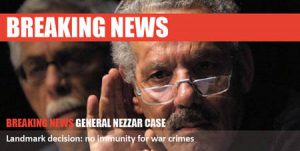
Geneva, 31 July  2012 – The Federal Criminal Court (FCC) released today a landmark decision in the case of Khaled Nezzar, an Algerian former defence Minister denounced by TRIAL for war crimes. The FCC found that Mr. Nezzar cannot claim immunity for acts committed during his tenure, thus paving the way for a trial in Switzerland. The present decision opens up significant possibilities in the fight against impunity based on the principle of universal jurisdiction

Khaled Nezzar, former General, Minister of Defence and member of the Algerian military junta in power in the early 1990s, was arrested in Geneva on 20 October 2011 following a denunciation by TRIAL (Swiss Association against Impunity) and a complaint of two victims, accusing him of war crimes committed during the early years of the Algerian civil war (1992-2002). Heard during two days by the Public Ministry of the Confederation, he was released upon his promise to participate in the subsequent procedure.

The criminal investigation, which continued in the presence of Mr. Nezzar’s counsel, was however suspended last January, following an appeal by Mr. Nezzar challenging the proceedings against him. In the appeal submitted to the FCC, Mr. Nezzar argued that his position as Minister of Defence and member of the junta at the time protected him from a possible criminal prosecution in Switzerland.

These arguments did not convince the federal judges. The FCC indeed took the view that one could not possibly invoke immunity for crimes of such a serious nature that they could amount to international crimes, notably war crimes, in the present case.

The FCC held that “it would be both contradictory and futile to, on the one hand, fight against these gross violations to the most fundamental human values and, on the other hand, to accept a large interpretation of the immunity rules […]”.

According to Philip Grant, director of TRIAL, “this decision sets a ground-breaking precedent that will have a significant impact beyond our borders and gives a very strong signal to executioners: in the future, they can no longer hide behind their official position to commit atrocities.”

The investigation will now continue, with the possibility for parties to call new witnesses to the stand. A war crimes trial might eventually take place in Switzerland against Mr. Nezzar.

Context

Mr. Nezzar held various management positions. Chief of Army in 1986, he was promoted to Chief of Staff and Minister of Defence in 1990. With this position, he became the man of all decisions within the government. From 1992 to 1994, at the beginning of the “dirty war”, he was one of the five members of the High Council of State (HCS), military junta replacing the elected president. In this respect, several human rights organisations accuse him of having ordered, authorised and encouraged the military and public servants to engage in acts of torture, commit extrajudicial killings, enforced disappearances and other acts constituting serious violations of international humanitarian law.

Swiss law allows for the prosecution of certain international law violations, including violations to the Geneva Conventions, as long as the suspect is present on Swiss territory. In the past, a Rwandan national has been sentenced in Switzerland to 14 years in prison for his participation in the Rwandan genocide.

For further information:

In 2008-2009, Mr Dias was the Major General of the 57th Division of the Sri Lankan army, tasked with attacking the Tamil Tigers during the final offensive against the rebel group. In this respect, he is alleged to have committed serious violations of the law of war. It is alleged that, from December 2008 to January 2009, the town of Kilinochchi was relentlessly shelled by his troops, destroying the entire infrastructure, including a hospital, and forcing tens of thousands of civilians into exile. It is also alleged that the 57th Division was involved in the bombardment of areas that had been defined as “no fire zones” and, therefore, supposedly safe zones for civilians, causing a veritable blood bath.

In September 2009, Jagath Dias was appointed Deputy-Ambassador of Sri Lanka to Switzerland, Germany and the Holy See. Based on a case put together by its partner ECCHR, TRIAL International and Société pour la protection des peuples menacés launched a campaign to get Mr Dias stripped of his diplomatic status. Faced with the passiveness of the authorities, in August 2011, the NGOs filed a criminal report against Jagath Dias before the Office of the Attorney General of Switzerland.

After this campaign, Mr Dias was dismissed in early September 2011. For the very first time, a diplomat had been fired on the grounds of suspected serious violations of human rights.

In dealing with the criminal complaint, the Office of the Attorney General of Switzerland decided to close the case. However, it stated that it would open an investigation into the important allegations of suspected war crimes against Mr Dias if he represented himself on Swiss territory. If that were to happen, it would be the first time for a judicial authority to acknowledge the commission of war crimes by the Sri Lankan army.