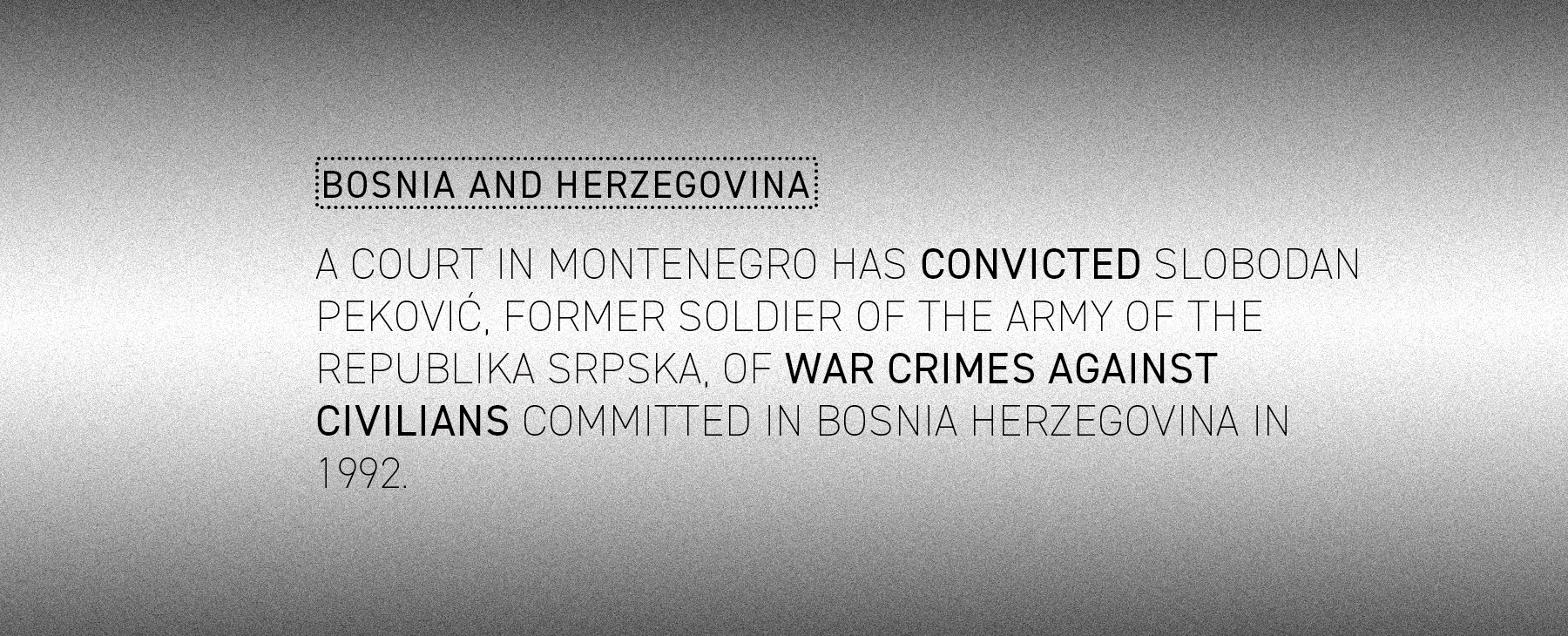
In the 1990s, war ravaged the former Yugoslavia. Bosnia and Herzegovina was particularly affected from 1992 to 1995, and although hostilities ceased several decades ago, the consequences are still felt today. In this post-war context, TRIAL International prioritizes advocacy and judicial capacity building for victims to invoke their rights.
Despite the establishment of an international tribunal (the ICTY, which closed in 2017) and numerous trials at a national level, many victims are still waiting for justice. Some criminals go unpunished, and even convictions do not always result in reparations for victims.
The Bosnian authorities constantly evoke the need to move on and forget the atrocities of war, but by adopting this attitude they neglect the rights and needs of many survivors.
What does TRIAL International do in Bosnia and Herzegovina?
TRIAL International has been working on Bosnia and Herzegovina since 2008. Its support first consisted of free legal assistance to victims of the war. It has achieved great victories before national courts and international bodies. New cases are now rarer, but the organization continues to support some of its earliest beneficiaries, simply because they still have rights to invoke – including the right to receive reparations for their sufferings.
To be compelling, the legal battle before courts and other jurisdictions must go hand in hand with long-term advocacy. In BiH, TRIAL International calls on the authorities to put into practice court rulings in favor of victims of serious crimes and to align their national legislation with international standards. In association with partner NGOs, TRIAL informs the international community about serious human rights violations taking place in the country, so that they can measure the urgent need for action.
Aligning Bosnian law with international standards
Today, TRIAL International focuses more on structural amendments to Bosnian law. It calls on the authorities to align national legislation with international human rights, such as access to reparations for victims of sexual violence. For example, in August 2019, the United Nations Committee Against Torture condemned the Bosnian authorities and ordered them to make reparations to a rape victim.
In addition, TRIAL International seeks to publicize its successes among legal professionals. A single precedent can thereby become a practice extended to the whole country. This is particularly important in view of the many political and jurisdictional levels in Bosnia and Herzegovina, which too often result in “double standards” for victims depending on where they live.
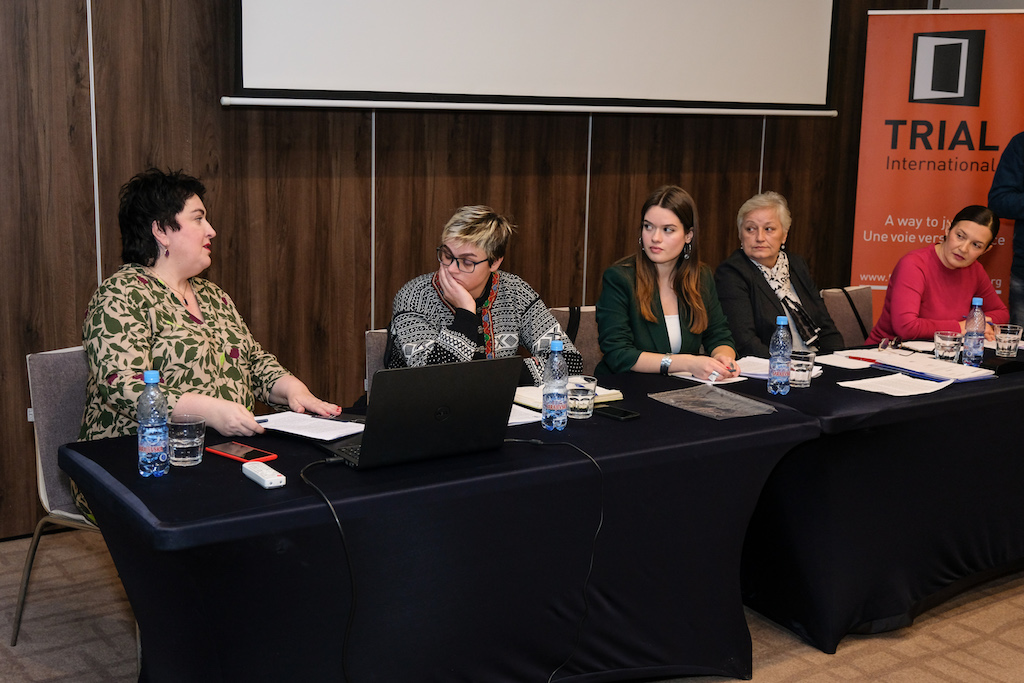
For this purpose, TRIAL International regularly organizes training for prosecutors, lawyers and judges. It also publishes legal guides to their intention.
Local structure
TRIAL opened an office in Sarajevo, the capital of Bosnia and Herzegovina, in 2011. Since then, its Bosnian staff have been working in an office located at 19 Čobanija in Sarajevo.
To provide the best experiences, we use technologies like cookies to store and/or access device information. Consenting to these technologies will allow us to process data such as browsing behavior or unique IDs on this site. Not consenting or withdrawing consent, may adversely affect certain features and functions.
Functional
Always active
The technical storage or access is strictly necessary for the legitimate purpose of enabling the use of a specific service explicitly requested by the subscriber or user, or for the sole purpose of carrying out the transmission of a communication over an electronic communications network.
Preferences
The technical storage or access is necessary for the legitimate purpose of storing preferences that are not requested by the subscriber or user.
Statistics
The technical storage or access that is used exclusively for statistical purposes.The technical storage or access that is used exclusively for anonymous statistical purposes. Without a subpoena, voluntary compliance on the part of your Internet Service Provider, or additional records from a third party, information stored or retrieved for this purpose alone cannot usually be used to identify you.
Marketing
The technical storage or access is required to create user profiles to send advertising, or to track the user on a website or across several websites for similar marketing purposes.