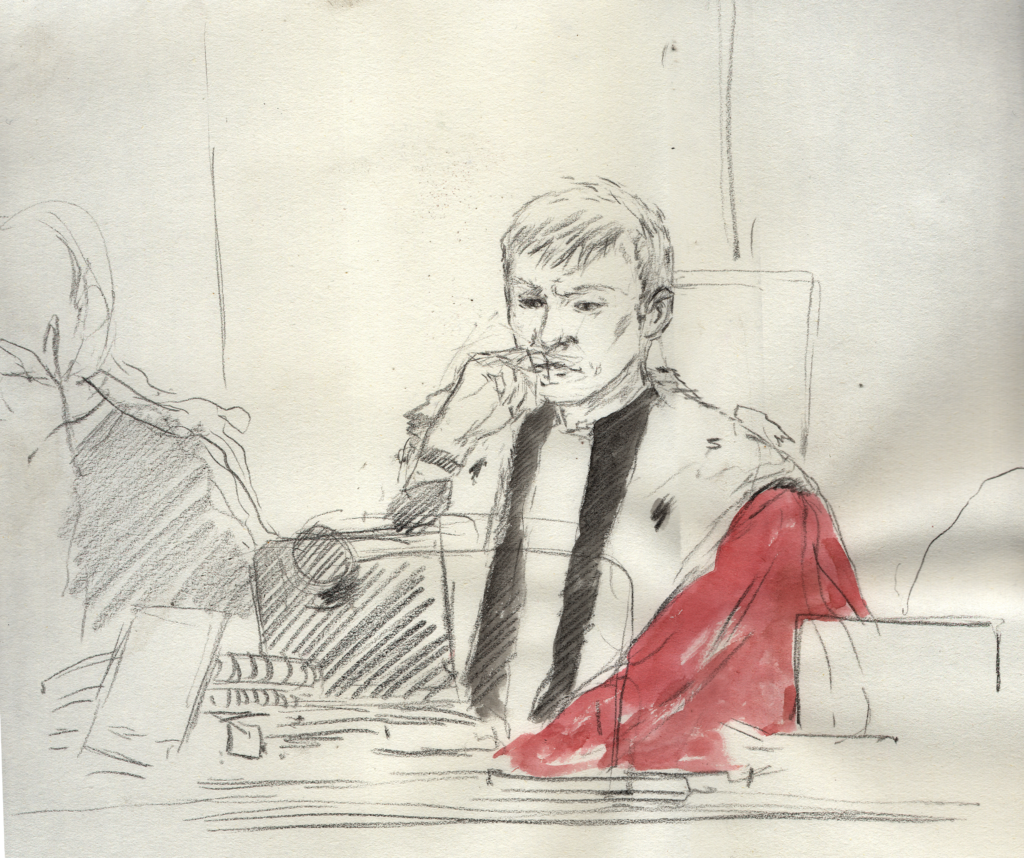
Khaled Nezzar case: No more hope for victims to obtain justice
The origins of the case
Hope was born on 22 October 2011, the day former Algerian Defence Minister Khaled Nezzar was arrested in Switzerland. Five victims had brought civil proceedings against him, accusing him of participating in the war crimes of torture, inhuman treatment, arbitrary detention and murder, as crimes against humanity.
The events allegedly took place during the early years of the Algerian civil war (1992-2002), when Khaled Nezzar was a member of the High Council of State, the ruling military junta. This made him one of the main players in the conflict between the Algerian government and various armed Islamist groups, which left nearly 200,000 people dead or missing.
A procedure which lasted 13 years
On 28 August 2023, Khaled Nezzar was charged with war crimes and crimes against humanity. Three months later, the Swiss Public Prosecutor’s Office announced that his trial would take place between 17 June and 19 July 2024. However, the defendant died a few days later. The proceedings were closed in June 2024 – 13 years after they began and three decades after the events took place. Khaled Nezzar would have been one of the most senior officials ever tried on the basis of universal jurisdiction.
On 10 March 2025, the Appeals Chamber of the Federal Criminal Court (FCC) rejected the request of two plaintiffs to have the case recognized as a denial of justice. They therefore lodged a complaint with the European Court of Human Rights on 7 July 2025, arguing that the investigation into Khaled Nezzar, which had been ongoing in Switzerland since 2011, had exceeded the requirements of expeditiousness applicable to criminal proceedings. The applicants concluded that Switzerland had violated this principle and, in particular, that the duration of the proceedings as a whole was unreasonable.
The final decision…
In a summary decision handed down on 16 October 2025, a single judge of the European Court of Human Rights declared the application inadmissible on the grounds that “the facts alleged do not disclose any appearance of a violation of the rights and freedoms listed in the Convention or its Protocols”. This decision is not subject to appeal.
TRIAL International deeply regrets this outcome, which puts an end to more than a decade of legal proceedings brought by survivors of international crimes committed in Algeria in the 1990s, whose courage and perseverance the organization commends.
According to lawyers Sophie Bobillier and Sofia Vega, representing one of the applicants, “this decision is regrettable and disappointing. On the one hand, the recognition that the victims had been waiting for years has once again been denied to them. On the other hand, this decision is a form of validation of the behavior of the Swiss authorities that was denounced by the applicants, namely political interference during the investigation and the lack of speed in investigating such serious crimes. This creates a risk that this behavior happens again in the future.”
… and its legal implications
Despite the huge disappointments experienced during the proceedings, the victims’ quest for justice has nevertheless contributed significantly to advancing the law. Indeed, the case first clarified the issue of functional immunities in a landmark decision handed down in 2012 by the Federal Criminal Court. This decision refused to recognize the immunity claimed by Khaled Nezzar, as it had ended when he ceased to hold the office of Minister of Defense. It has had an impact well beyond national borders, as it is now quoted by other national courts called upon to rule on this issue[1].
Furthermore, the proceedings in Switzerland provided legal confirmation of the existence of a non-international armed conflict during Algeria’s ‘black decade’, with the FCC also finding in its decision of 30 May 2018 that Khaled Nezzar had been aware of the acts committed under his orders in this context.
Therefore, although the European Court of Human Rights’ decision of inadmissibility puts an end to the legal proceedings in this case, it cannot erase the progress made or the advances achieved. The survivors involved have thus contributed to advancing the central issue of immunity in these proceedings, but also to strengthening the foundations of the fight against impunity in Switzerland and other countries applying the principle of universal jurisdiction.