On 31 March 2026, the Criminal Division of the Swiss Federal Criminal Court (FCC) issued an order to close the case against Rifaat al-Assad following his death. The case had been referred to it on 11 March 2024 with an indictment by the Office of the Attorney General of Switzerland, following more than 10 years of investigation into one of the most atrocious massacres in the country’s history, perpetrated in the city of Hama in February 1982.
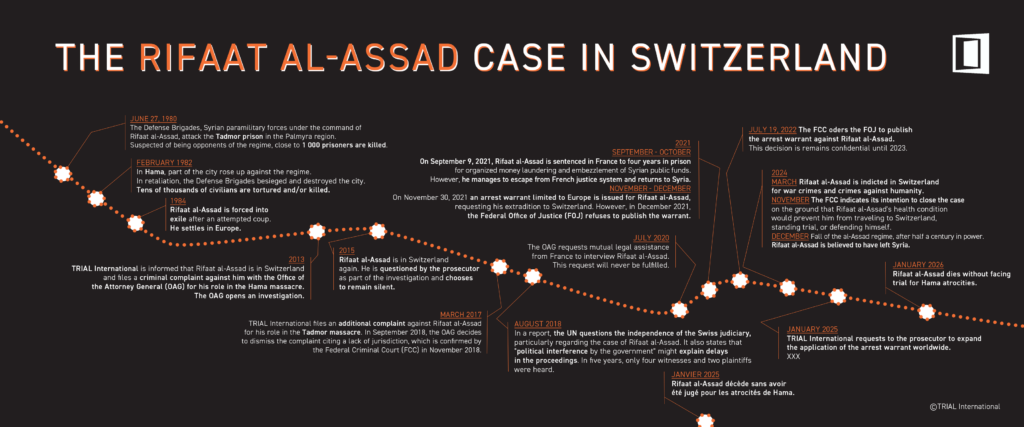
 

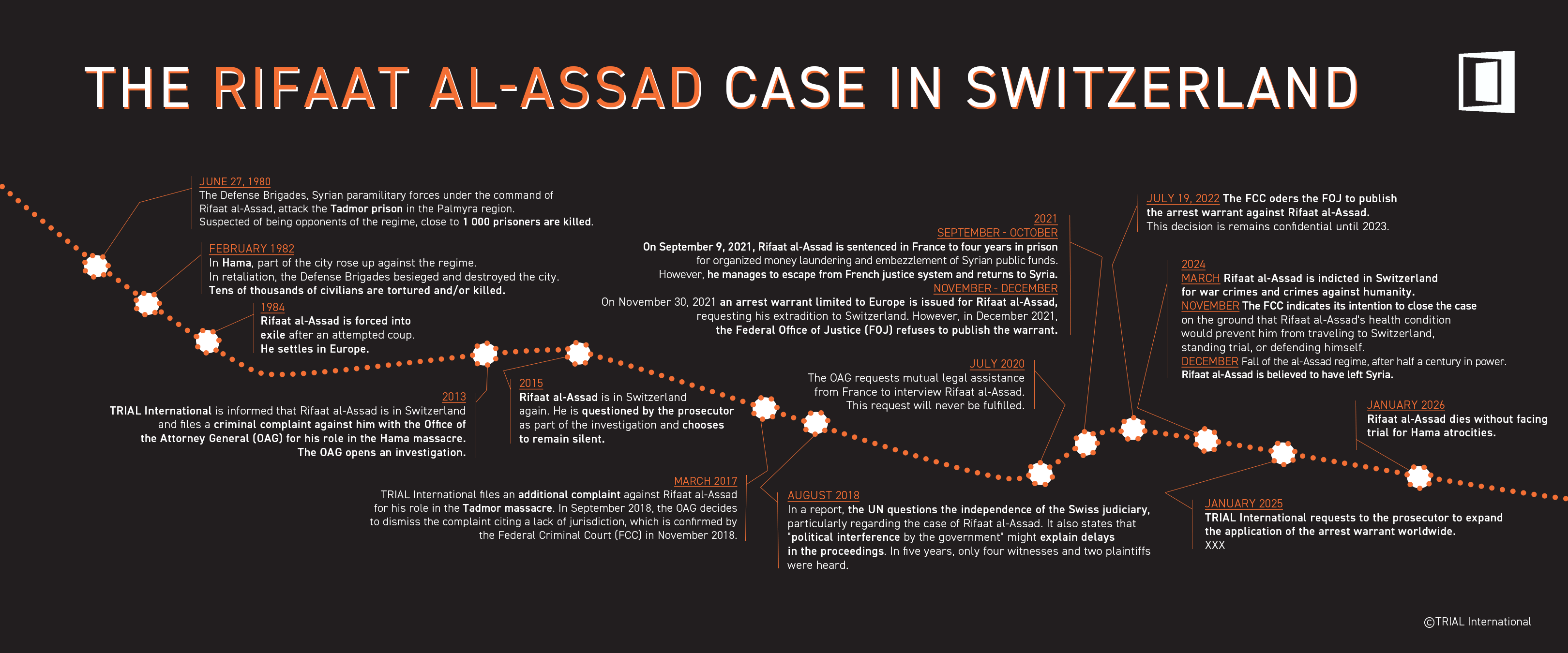
Infographic of the Rifaat al-Assad case


Whilst this decision brings the proceedings to a final closure, it in no way diminishes the courage and significance of the efforts made by the plaintiffs to establish the criminal liability of one of the strongmen of the fallen Syrian regime. The closure of the case is all the more difficult for the victims and survivors of these atrocities, as a trial finally seemed to be on the horizon. This would have taken place against the favourable backdrop of a Syria under reconstruction.

However, this case cannot be reduced to a failed legal proceeding. It constitutes a historic precedent in the fight against impunity for crimes committed in Syria. The investigation conducted in Switzerland, which led to the issuance of an indictment for war crimes and crimes against humanity, will remain a significant legal achievement.


A historic indictment

The indictment of Rifaat al-Assad on 11 March 2024 will go down in history. Indeed, for the first and probably only time, a judicial authority investigated the events in Hama and concluded that war crimes and crimes against humanity had been committed. The Swiss proceedings thus helped to enshrine this memory in the record of the law, defining these atrocities as crimes that shock the conscience of humanity as a whole.

Survivors, the families of the disappeared and Syrian civil society have been asserting it for decades: the violence committed in Hama was part of a policy of massive, organised and systematic repression. The destruction of an entire city, extrajudicial executions, enforced disappearances and acts of torture have left a lasting impression and a deep scar on the population.


The charges against Rifaat al-Assad

In its preamble, the indictment of 11 March 2024 states that:

“Rifaat al-Assad, then commander of the Defence Brigades (or “Saraya al-Difaa”), a unit of the Syrian security forces, and commander of operations in Hama in February 1982, [had] ordered the commission of several violations of the laws of war and crimes against humanity, [he] namely ordered the troops under his command to comb the city and execute the inhabitants of Hama.” In this context, according to the prosecution, Rifaat al-Assad “held meetings during which he ordered the forces under his command to eradicate the people of Hama because they were a people of traitors and because the population of Hama was working for Iraq and the Muslim Brotherhood; for these reasons, they had to be eliminated.”

Noting that the attack carried out by Syrian forces in Hama in February 1982 marked “the climax” of the armed conflict that was raging at the time, the prosecution then sets out in detail the abuses alleged by the plaintiffs. These charges were brought against Rifaat al-Assad, to whom “unlimited” powers had been entrusted by his brother Hafez, then President of Syria, with the aim of “completely cleansing the rebellious cities”. In particular, the charges concerned mass killings, cruel treatment, acts of torture and the illegal detention of thousands of civilians.

“The Hama massacre marks a turning point in the takeover of the country by the al-Assad clan. Beyond the criminal prosecution of Rifaat al-Assad, it is the responsibility of his brother Hafez and that of other regime officials that is highlighted by this case.”

Anwar al-Bunni[1] during a meeting with TRIAL International in 2022

The key role of the plaintiffs

At the heart of the proceedings, which began in 2013, are three survivors who filed criminal complaints against Rifaat al-Assad for acts that they themselves and/or their relatives had experienced. Their commitment must be highlighted and commended here: without their key testimonies, TRIAL International’s complaint might not have led to the opening of an investigation, given the complexity of the inquiry into events that are both long past and distant.

“I wanted everyone to know what this man did and for him to be punished.”

Extract from the minutes of a complainant’s hearing before the Federal Prosecutor as part of the investigation against Rifaat al-Assad in Switzerland.

“The Assad family ruled Syria for 54 years and destroyed the country. I filed a complaint against Rifaat al-Assad and the Swiss prosecutor charged him with the crimes committed in Hama. The whole world rejoiced at the fall of the regime. It was a day of joy for everyone. […]. A day will come when the truth will come to light, for injustice will not last forever. May God ensure that we obtain justice in this world and in the hereafter. That is my only wish.”

Statement by a complainant on the Rifaat al-Assad case to TRIAL International, following the fall of the Syrian regime in late 2024.

Their involvement has helped shed light on the crimes suffered by all the victims of the massacre: families who still do not know the fate of their loved ones, and people who have been living with this trauma for over forty years.

“According to the figures, around 40,000 people were murdered in Hama, and we still do not know who killed them. Again, according to the available figures, there were around 250 members of the Muslim Brotherhood in Hama in February 1982. To me, this means that many innocent people were killed in Hama.”

Extract from the minutes of a hearing of a plaintiff before the Federal Prosecutor as part of the investigation against Rifaat al-Assad in Switzerland.

In Syria, the regime maintained its power and control over the population for almost the entire duration of the proceedings, right up until the end of 2024. The safety of the plaintiffs, even in exile, was under threat, as was that of their families, who were all the more vulnerable as they were still in Syrian. Thus, their decision to take part in these proceedings and hold those close to the regime to account was a powerful act.

“I want this criminal to be punished. He committed war crimes and nobody has spoken about it. I decided to speak out because I want everyone to know what he did. I want justice and I know that Switzerland can help me. This happened years ago and I know that Switzerland prosecutes cases like this. My aim is to uphold justice.”

Extract from the minutes of a hearing of a plaintiff before the Federal Prosecutor as part of the investigation against Rifaat al-Assad in Switzerland.

Aware of the importance, but also the rarity, of their testimonies, the Office of the Attorney General of Switzerland decided – in an order dated 7 June 2017 – that one of the plaiintiffs would remain anonymous. The objective reasons the person had for fearing for its own safety or that of its loved ones were taken into account, given the character of Rifaat al-Assad, who has remained influential in Syria since his exile in Europe. Bashar al-Assad’s uncle enjoyed unwavering support.

In the Rifaat al-Assad case, the complainants have maintained unwavering commitment and exemplary determination,” said Benoit Meystre, Legal Adviser at TRIAL International. “Despite the slowness of the proceedings, despite the uncertainty surrounding the outcome of the investigation, despite the time that had passed between the events and their judicial examination, and despite the pressure sometimes exerted even by their own families in view of the dangers involved, they never gave up,” he added.


Support from Syrian civil society

This case is also part of a broader movement driven by Syrian civil society. For several years, survivors, victims’ associations, lawyers, researchers, journalists and human rights defenders have been collecting and preserving evidence of crimes committed by the former Syrian regime, thereby making these trials possible.

In 2022, ten cases were pending against Syrian officials in Germany, Austria, Belgium, the Netherlands, Sweden and Switzerland. Several other cases against officials of the Syrian regime have been initiated since then, often in collaboration with Syrian human rights activists. Without this patient work, often carried out under difficult conditions, many of the cases currently being brought in Europe under the principle of universal jurisdiction would not have been possible.

However, the assessment made by Syrian civil society paints a mixed picture of the use of universal jurisdiction, a mechanism designed to prosecute international crimes regardless of where they were committed, the nationality of the perpetrators or that of the victims. Indeed, “despite its growing importance, [universal jurisdiction] remains hampered by structural constraints, particularly those linked to the political calendar and the lifespan of the perpetrators, as well as disparities in judicial willingness between different legal systems”[2].


What will remain of the Rifaat al-Assad case

The closure of the proceedings following the death of Rifaat al-Assad leaves a sense of unfinished business on which there is consensus among survivors, the victims’ families and Syrian civil society: the accused will face neither his judges nor his victims. There will be no public trial, let alone a verdict.

Yet the investigation did take place, evidence was gathered, the facts were examined and legally classified, and witnesses were heard. An indictment was issued. The self-sacrifice of the plaintiffs, going far beyond the scope of their personal circumstances, has made it possible to inscribe the tragic events of Hama indelibly into Syrian history and the realm of justice.


[1] Anwar Al-Bunni was born in Hama in 1959. He is a lawyer and human rights defender. In Syria, he defended numerous political prisoners before being imprisoned for his activism. He left Syria in 2014 and was granted asylum in Germany, where he currently resides. He was instrumental in the prosecution and conviction of Anwar Raslan in that country. The full interview is available here: https://trialinternational.org/fr/latest-post/affaire-rifaat-al-assad-9-annees-despoir-et-dincertitudes/

[2] Fadel Abdulghany, “The death of Rifaat al-Assad: Accountability, Asset Recovery, and the Incomplete Structure of Syrian Justice”, 22 January 2026. Article available here: https://fadelabdulghany.net/blog/2026/01/22/the-death-of-rifaat-al-assad-accountability-asset-recovery-and-the-incomplete-structure-of-syrian-justice/
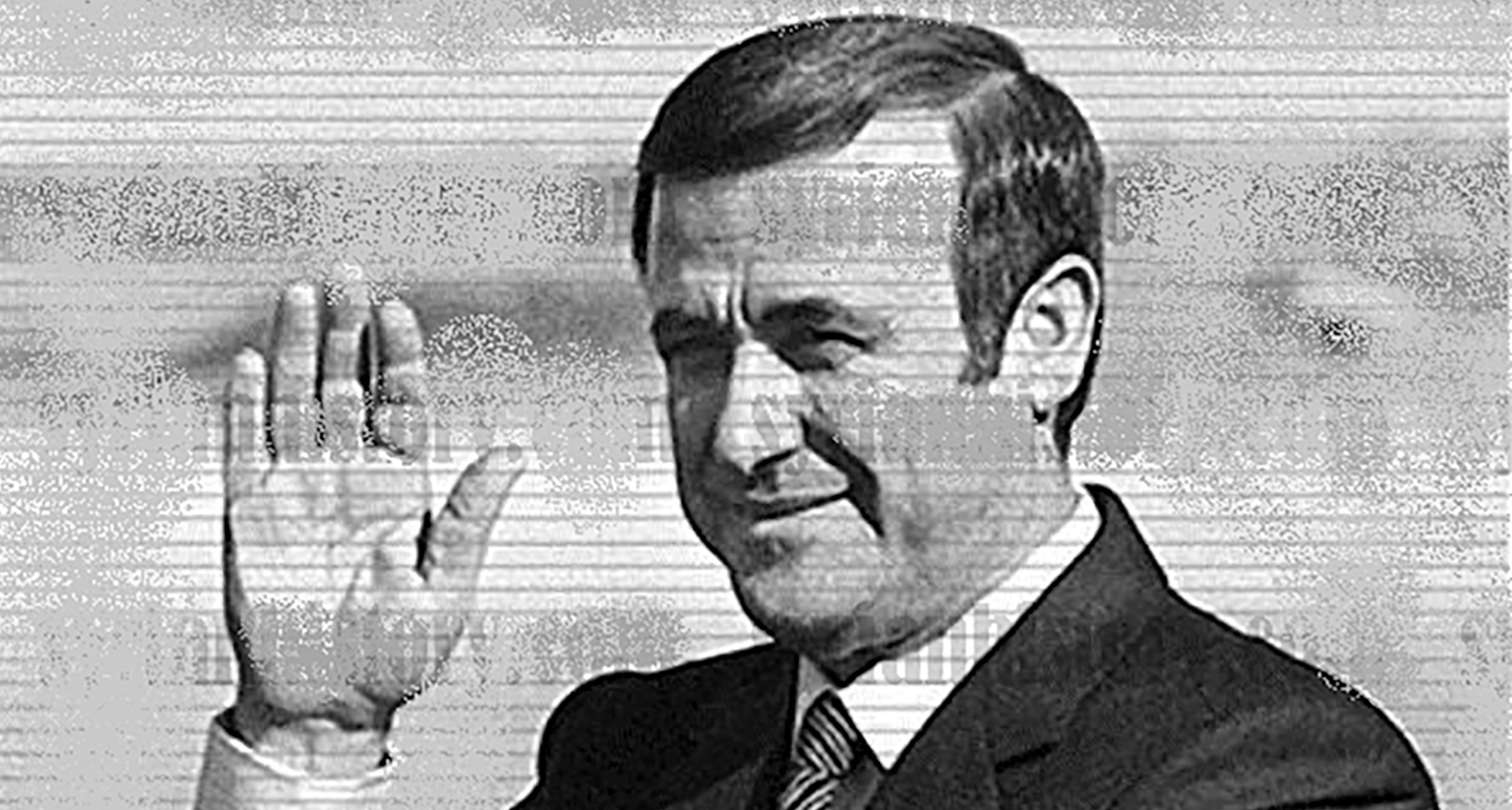
Rifaat al-Assad, former Syrian vice-president indicted in Switzerland for war crimes and crimes against humanity, reportedly died on 20 January 2026 in the United Arab Emirates, at the age of 88. Syrian plaintiffs had long hoped that he would stand trial in Switzerland for the infamous Hama massacre, but his death closes a significant chapter in their quest for justice. TRIAL International had repeatedly expressed concern about the length of the proceedings, which lasted more than a decade, and deeply regrets the outcome of this historic case. 

Information about the death of the “Butcher of Hama” has been widely reported today. A key figure of the Assad regime and uncle of former President Bashar al-Assad, Rifaat al-Assad returned to Syria in 2021 to avoid serving a four-year prison sentence in France for money laundering and misappropriation of Syrian public funds. He remained in the country until the fall of the Syrian regime in December 2024, after which – according to information disclosed today – he had fled to the United Arab Emirates.

Rifaat al-Assad’s death comes almost two years after his indictment by the Office of the Attorney General of Switzerland (OAG), bringing an end to proceedings that had been stalled before the Federal Criminal Court by prolonged debates over his ability to stand trial.

The Swiss case was intended to examine his alleged criminal responsibility as the commander of the Defence Brigades for atrocities committed on the city of Hama launched on 2 February 1982 by Syrian government forces. The operation, aimed at suppressing an armed uprising against the regime, lasted nearly a month, during which civilians were trapped inside the city; between 10,000 and 40,000 civilians are reported to have been killed, while countless others were tortured and forcibly disappeared.

Today is a deeply unjust day. We have been fighting since 2013 for justice to be done. Even so, the proceedings made it possible to achieve important objectives, including the issuance of an arrest warrant and his indictment for what he did to the people of Hama,” said a Syrian plaintiff in the Swiss proceedings.

Despite repeated calls by TRIAL International to proceed urgently in light of the advanced age of the parties, the case will now be unheard, and Syrian victims’ questions will remain unanswered.

This abrupt end to the legal proceedings echoes another universal jurisdiction case opened in Switzerland: that of Khaled Nezzar, former Algerian defence minister. His case, like that of Rifaat al-Assad, concerned war crimes and crimes against humanity, was also closed following the death of the accused, after more than a decade long investigation. Together, these cases illustrate the severe delays that continue to hinder proceedings for international crimes in Switzerland, undermining victims’ access to justice.

Benoit Meystre, Legal Advisor at TRIAL International, expressed profound disappointment: “These cases were historic not only because they sought justice for massive crimes committed in Syria and Algeria, but also because they represented a broader effort to challenge the pervasive impunity in both countries, where countless victims have waited decades for accountability.

TRIAL International urgently calls on Switzerland to provide its investigating and prosecuting authorities with the resources and safeguards necessary to ensure that such cases are handled efficiently and without unnecessary delay.

On 8 December 2024, after more than five decades of the al-Assad clan’s rule, Syria’s history was turned upside down in just a handful of days. Since the offensive by anti-government forces at the end of November, the rebel advance has been dazzling. One by one, towns whose names resonate in the collective consciousness, such as Aleppo, Hama and Homs, have fallen into the hands of the armed opposition groups, followed by the fall of Damascus. With the collapse of the regime, the whereabouts of Bashar al-Assad and his family remain at the heart of interrogations, although it was soon confirmed that Russia had granted him political asylum.

The Syrian government implemented a policy of repression that turned into open conflict with the Muslim Brotherhood, which became the main opposition force to Hafez al-Assad after he came to power in the late 1970s. From 1979 to 1982, the regime confronted its fighting vanguard. This conflict was marked by a number of emblematic events, such as the Tadmor prison massacre in 1980 and the destruction of the town of Hama in 1982. The election in 2001 of Bashar al-Assad, son of the previous president, saw the birth of the Damascus Spring and hopes of reform. But in the autumn of the same year, the authorities cracked down on the opposition movement, imprisoning its leaders and killing more than 3,500 people. Ten years later, the ‘Arab Spring’ inspired a series of peaceful demonstrations. Its deadly repression by the Syrian security apparatus triggered a civil war that has left the country on fire and the economy in ruins.

Rifaat al-Assad is a key figure in the dynasty. Former Syrian vice-president and uncle of deposed President Bashar, he has been the subject of proceedings in Switzerland since 2013 for his alleged role as commander of the ‘Defence Brigades’ in the infamous Hama massacre of February 1982. The Swiss Office of the Attorney General (OAG) issued an international arrest warrant for him in November 2021. However, this did not prevent Rifaat al-Assad from fleeing France, where he had just been sentenced to four years in prison for ill-gotten gains. After more than ten years of investigation, the OAG finally filed an indictment agains him in March 2024 for war crimes and crimes against humanity.

However, at the end of November 2024, the Swiss Federal Criminal Court (TPF) indicated that it wanted to close the case on the grounds that Rifaat al-Assad’s state of health would not allow him to travel to Switzerland or attend his trial. Even though no final decision has yet been taken, such a move at this pivotal moment would be running against the tide of history, which demands justice for the victims of the Hama massacre and, more generally, for the liberated Syrian people. Countless victims have been waiting for decades for the regime to be held to account.

If Rifaat al-Assad, like the rest of the al-Assad family, has fled his region in Syria or abroad, then the argument of his alleged inability to travel would no longer hold. It would therefore be an opportune moment not only to propose trial dates for al-Assad, but also to expand or renew the channels for the dissemination of his arrest warrant. This would also give fresh impetus to the investigations underway in several other European countries, such as France, the UK and Spain, where significant assets have been seized in recent years. In the current situation, it is more imperative than ever that they be returned to the Syrian people.

With many allies of the ousted Syrian regime likely to flee, universal jurisdiction should continue to play its part in the quest for truth and justice by countless victims of atrocities committed in Syria in the past decades. Switzerland could be the first country to open an exemplary trial against one of the members of the al-Assad clan and thus play an active part in ending the impunity of the outgoing Syrian regime.

(Geneva, 12 March 2024) – Former Syrian Vice-President Rifaat al-Assad will stand trial in Switzerland for war crimes and crimes against humanity. The Office of the Attorney General (OAG) has just charged him with ordering homicides, acts of torture, cruel treatments and illegal detentions perpetrated in the course of the February 1982 massacre in the city of Hama, Syria. With today’s indictment, the victims can finally look forward to justice being done. Rifaat al-Assad, the uncle of current Syrian President Bashar al-Assad, will be one of the highest-ranking government officials ever to be tried for international crimes based on the principle of universal jurisdiction.

Rifaat al-Assad, commander of the Defense brigades in the 1980s

After issuing an international arrest warrant against Rifaat al-Assad in November 2021, the OAG indicted him on 11 March 2024 for war crimes and crimes against humanity. The proceedings concern the massive war crimes committed in the city of Hama, Syria, in February 1982 by the Defense brigades. The three weeks siege and assault of the city led to the death of between 10,000 and 40,000 people, many of whom civilians, as well as to numerous acts of torture, sexual violence and enforced disappearances. At the time, Rifaat al-Assad was the commander of the Defense brigades, the Vice-President of Syria, as well as the head of operations in Hama.

At the beginning, I could not even dream about having Rifaat al-Assad being brought to trial. The indictment shows that such powerful persons can be brought to justice and I want everyone to know what the al-Assad regime did to the Syrian people. My fight is for all the Syrians”, said one of the three plaintiffs in the case, expressing the feeling of all survivors of the assault, who have been waiting for this moment for over 40 years now.

In 2013, TRIAL International filed a criminal denunciation in Switzerland against Rifaat al-Assad, that quickly led to the opening of a formal investigation. Since then, the accused, who was residing in neighboring France, persistently refused to testify before the Swiss prosecuting authorities, under various pretexts. He fled back to Syria in October 2021, to escape a 4-year prison sentence handed down by French courts for various financial crimes, but also his forthcoming audition by the OAG, that was about to be organized, based on a mutual legal assistance request from Switzerland to France.

Philip Grant, Executive Director of TRIAL International welcomed the historical indictment of such a prominent figure: “It’s another step for justice for the Syrian people! This case, along with past and ongoing groundbreaking proceedings, notably in Germany and France, is looking at the responsibility of the highest Syrian officials and strongly contributes to shedding light on the crimes committed by the al-Assad’s clan against its own people during the past decades”.

The criminal investigation and forthcoming trial against the so-called “Butcher of Hama” are possible thanks to the application of the principle of universal jurisdiction, which allows States to investigate and prosecute persons suspected of having committed international crimes, irrespective of where the crimes were committed and the nationality of either suspects or victims.

TRIAL International recalls the Swiss authorities that time is of the essence and plays against justice, as Rifaat al-Assad is aging. More than 40 years after the massacre of Hama, Rifaat al-Assad’s trial must take place at the earliest possible moment, irrespective of the fact that Rifaat al-Assad will very likely decide not to attend his own trial.

Ten years ago, to the day, the Office of the Attorney General (OAG) of Switzerland, opened a criminal investigation for war crimes against former Syrian Vice-President Rifaat al-Assad. A criminal complaint had been filed by TRIAL International just days prior, while Mr. al-Assad was present in Switzerland. Throughout these years, TRIAL International has continued to support the plaintiffs in their quest for justice.

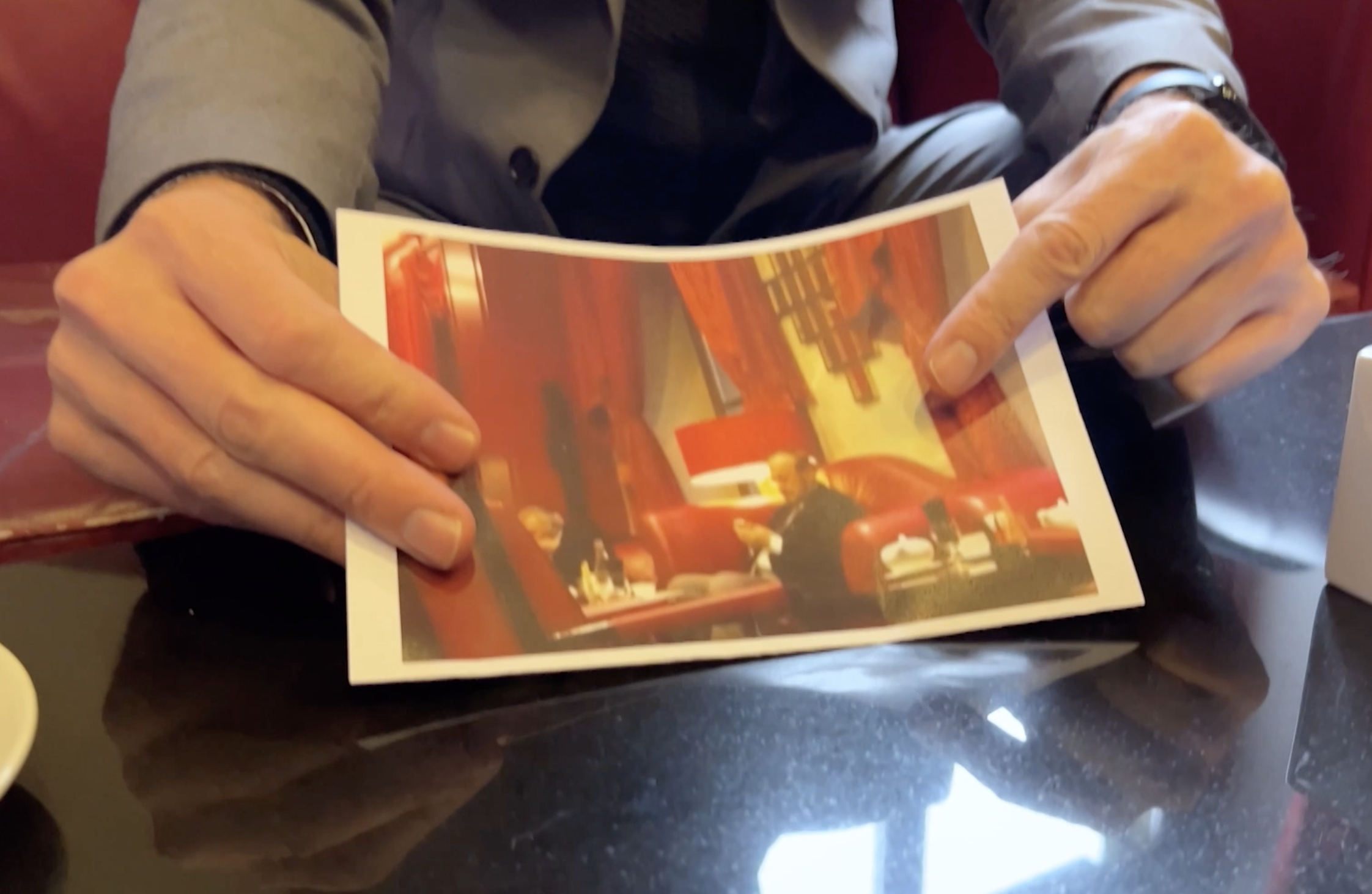
Screenshot video_PG Hotel Rifaat holding picture
Philip Grant, Director of TRIAL International, sitting on the same sofa in a hotel in Geneva, where Rifaat al-Assad was spotted in December 2013, holding the picture that had been made of Mr. al-Assad ten years ago.

Since December 2013, Rifaat al-Assad has been under investigation for his alleged role in the massacres committed in the Syrian city of Hama in February 1982 by the “Defense brigades”, that he commanded at the time. Alongside the regular Syrian army, Rifaat al-Assad’s troops are suspected of having participated in the three-week siege and assault of the city that caused between 10’000 and 40’000 deaths, mainly civilians. Executions, enforced disappearances, rape and torture were committed on an unimaginable scale. Entire neighborhoods were destroyed during the attack.

The criminal investigation against the “Butcher of Hama” is based on the principle of universal jurisdiction, which allows States to investigate and prosecute suspects of international crimes, irrespective of where they were committed and the nationality of either suspects or victims.

The OAG has only once briefly interrogated Mr. al-Assad in September 2015, when he was again present in Switzerland. After more than 3 decades in exile, mostly in France, Rifaat al-Assad fled back to Syria in October 2021 and to the protection of his nephew, Bashar al-Assad. An international arrest warrant issued by the Swiss prosecuting authorities against Rifaat al-Assad was only made public on 16 August 2023.

After so many years and a winding procedure, the victims are still waiting for light to be shed on the crimes committed in Hama by the Syrian regime against its own people. The massacre that took place in 1982 is engraved in people’s mind as a landmark moment in the recent history of Syria. The lack of accountability for past crimes has fueled the brutality of the al-Assad regime, whose violence since the beginning of the revolution has already been qualified as crimes against humanity by a German court.

The three plaintiffs in the case eagerly await the filing of an indictment and the opening of a trial. TRIAL International urges the Swiss authorities to expedite the judicial process, as justice delayed is justice denied. With Mr. al-Assad now 85, any further delay risks depriving the victims of their right to justice.

The prospective trial of Mr. al-Assad in Switzerland would be groundbreaking. Rarely are such high-ranking officials tried for international crimes based on the principle of universal jurisdiction. It would send a powerful message that those in power in Syria, even when their name is al-Assad, are not beyond the reach of justice.

Rifaat Al-Assad is a career military man and a Syrian politician. He is the younger brother of the former president of Syria Hafez Al-Assad, to which he has largely facilitated the ascension to power in 1970. He is the uncle of the current president Bashar Al-Assad.

A member of the highest political circles in the 1980s, he was part of the regional commandment of the Baath party and has led the “Defense Brigades” (Saraya al-difaa an al thawara), Syria’s elite commando troops, from 1971 to 1984.

Thought by many to succeed to his elder brother as president, he was then suspected of preparing a coup against the latter. He was subsequently forced into exile in 1984. Since then, he has lived in various European countries where he has invested his substantial personal fortune.

In June 2016, he was indicted in France for embezzlement of public funds and undeclared labour. Some of his assets, worth several million euros, were seized in France, in Spain and in the United Kingdom.


The facts

Under Rifaat Al-Assad’s command, the Defense Brigades could have participated in two infamous slaughters.

Firstly, the massacre in the prison of Tadmor (or Palmyra), probably perpetrated by the Defense Brigades in retaliation to the attempted murder of President Hafez Al-Assad.

On 27 June 1980, the Defense Brigades led by Rifaat Al-Assad attacked the prison of Tadmor, around 200km North-East of the capital. As soon as they arrived, the soldiers barged into the cell and killed almost every prisoner. About 1’000 people suspected of being members of the opposition could have been slaughtered.

Secondly, the martyrdom of the city of Hama in February 1982. Following the takeover by the Fighting Vanguard of the city of Hama, the government sent in thousands of men, including the Defense Brigades.

Government forces surrounded and shelled the city with heavy artillery and tanks. The Vanguard and many individuals who had spontaneously taken arms tried to resist, in vain. Very quickly, the civilian population was trapped in its own city, cut off from supply, food and electricity for almost 4 weeks.

Depending on the sources, 10’000 to 40’000 people – mainly civilians – have died. Whole areas of the city were destroyed, including the shelling to the ground of a part of the old town.

Both at Tadmor and in Hama, testimonies and historical sources concur on the implication of the Defense Brigades in the crimes committed. Several sources point directly at Rifaat Al-Assad in the planning and carrying out of these massacres.


Procedure

In November 2013, TRIAL International was made aware of the presence in Switzerland of Rifaat al-Assad. After conducting research, the NGO filed a complaint before the Office of the Attorney General of Switzerland (OAG), asking it to determine the responsibility of Rifaat Al-Assad in the massacre of Hama. The OAG opened a criminal investigation for war crimes in December 2013. In August 2014, a victim joined in the proceedings.

In September 2015, Rifaat Al-Assad came back to Geneva. TRIAL International and the victim’s lawyer asked the authorities to arrest him. They refused, and the victim’s lawyer filed for provisional measures before the Federal Criminal Tribunal. Two days later, the OAG was ordered to audition Rifaat Al-Assad.

In 2016 and 2017, TRIAL International filed several more complaints, including for the crimes committed in Tadmor. It also brought to the case ample evidence and a list of witnesses ready to testify.

As the proceedings continued, six more victims joined the case. Some of them have directly witnessed the atrocities. Given the total impunity reigning in Syria, the investigation in Switzerland could be their only chance to obtain justice.

In June 2020, Rifaat al-Assad was convicted in France and sentenced to four years in jail, notably for money laundering and embezzlement of Syrian public funds. French authorities also confiscated several properties worth millions. Al-Assad appealed the decision.

On 9 September 2021, the Paris Court of Appeals upheld the conviction of Rifaat al-Assad to four years in prison for fraudulently building up assets in France valued at 90 million euros.

In October 2021, Rifaat al-Assad fled Europe to return to Syria despite the ongoing proceedings against him and the judicial surveillance he was under in France. The investigation before the OAG continues regardless.


Context

From 1979 to 1982, the Al-Assad regime fought the Fighting Vanguard of the Muslim Brotherhood. Founded at the end of World War II and emanating from the Egyptian party, the Syrian branch of the Muslim Brotherhood became the first opposition force after Hafez Al-Assad’s accession to power.

The regime, including under the influence of Rifaat Al-Assad, set up a policy of repression that evolved into open conflict with the Muslim Brotherhood. At the end of the 1970s, their clashes led to an armed conflict which culminated in the destruction of Hama in 1982.

The crimes committed in Hama and Tadmor are directly linked to that non-international armed conflict in Syria. The following acts must therefore be qualified as war crimes:

  • murder
  • collective punishments
  • bombardment of civilians
  • collective executions
  • acts of torture
  • rape
  • looting
  • destructions of religious buildings and hospitals